Introduction
Altitude sickness on Indian Himalayan treks is the one hazard where being fit actively works against you. A Sahyadri trekker who has done Harishchandragad in the rain, Kalsubai before dawn and AMK in a single push arrives in Leh or at Sankri believing the body is the variable. It is not. Acclimatisation is a chemical process on a fixed clock, it does not care how strong your legs are, and there is decent reason to think that the fittest people in a group are at higher risk simply because they ascend faster and push through symptoms longer.
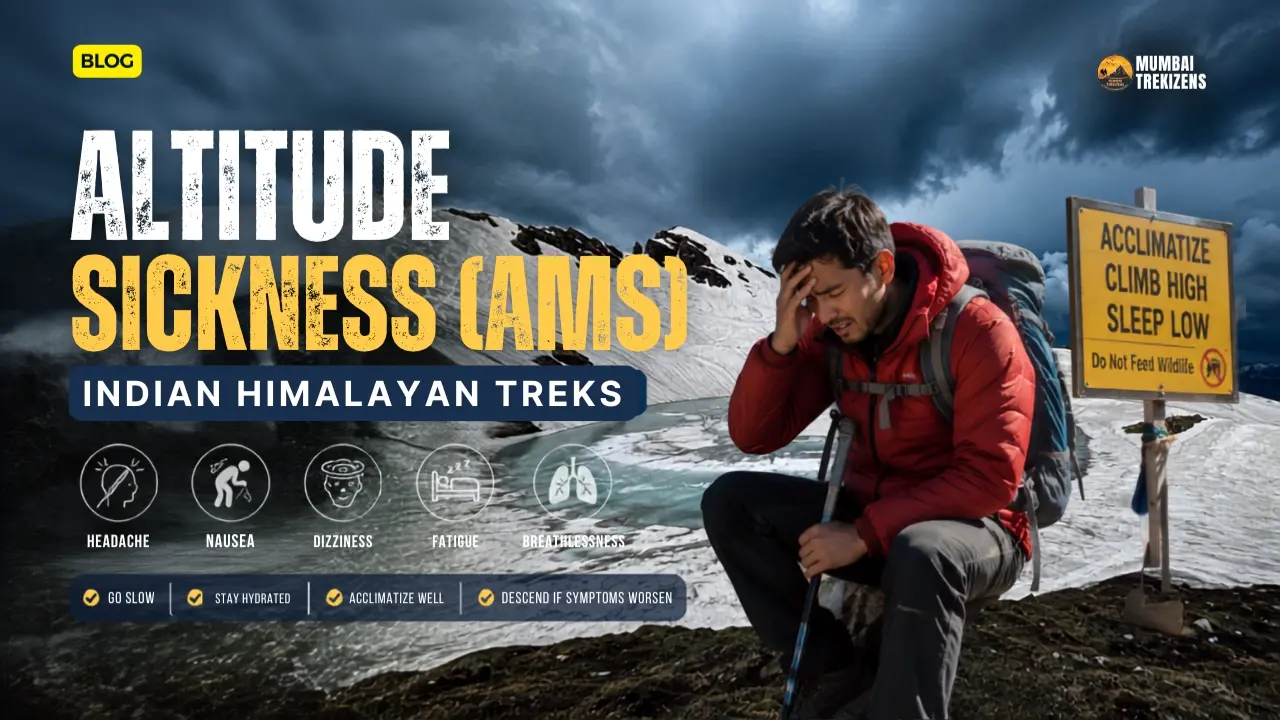
The condition itself is common and mostly benign. Acute mountain sickness feels like a hangover you cannot shift and it resolves if you stop climbing. The two that kill are High Altitude Pulmonary Edema and High Altitude Cerebral Edema, and both can go from "he's a bit tired" to a corpse inside twelve hours.
There is one treatment. Everything else is a delaying tactic. Go down.
This is general safety guidance for trekkers, not a substitute for professional medical care. Altitude illness needs a doctor and, most of the time, an immediate descent.
Table of Contents
- Why Altitude Makes You Ill
- Acute Mountain Sickness: What It Actually Feels Like
- The Lake Louise Score
- HAPE: The Lungs
- HACE: The Brain
- Descent Is the Only Real Treatment
- Oxygen, Drugs and Hyperbaric Bags
- The Ascent Rules That Prevent All of This
- Ladakh: The 48-Hour Rule, and Manali Road vs Flying In
- Uttarakhand and Himachal Treks: The Real Altitudes
- Kedarnath and Amarnath: The Yatra Problem
- Why Sahyadri Fitness Fools You
- Common Mistakes
- Best Time and Seasonal Risk
- Emergency Contacts
- Frequently Asked Questions
Why Altitude Makes You Ill
The percentage of oxygen in the air does not change with altitude. It is around 21 percent at Marine Drive and around 21 percent on Stok Kangri. What changes is barometric pressure. Lower pressure means fewer oxygen molecules per breath, so less oxygen crosses into your blood. That is hypobaric hypoxia.
At roughly 3,500 m you are taking in around two-thirds of the oxygen available at sea level. At 5,000 m, around half.
Your body responds by breathing faster and deeper, raising heart rate, and over days producing more red blood cells and shifting kidney chemistry to compensate for the respiratory alkalosis that fast breathing causes. Those adaptations take days, not hours. Altitude illness is what happens in the gap between the altitude you have reached and the altitude your body has adapted to.
The threshold generally used is 2,500 m. Below that, altitude illness is uncommon. Above it, the risk climbs with height gained, speed of gain, and sleeping altitude. Sleeping altitude matters more than the highest point you touched during the day, which is the entire basis of the "climb high, sleep low" rule.
Individual susceptibility varies enormously and is largely genetic. Your previous history at altitude is the single best predictor of how you will do next time. Fitness is not a predictor. Age is barely a predictor. Sex is not a predictor.
Acute Mountain Sickness: What It Actually Feels Like
AMS is the mild end and it is common. On a fast ascent to 4,000 m and above, a substantial fraction of any group will get some of it.
The core symptom is headache. Frontal or global, throbbing, worse when you bend forward, worse at night, poorly responsive to painkillers. In practice, no headache, probably no AMS.
Then, in addition:
- Nausea, loss of appetite, or vomiting
- Fatigue and weakness out of proportion to the day's effort
- Dizziness or light-headedness
- Poor sleep, waking repeatedly, and the strange periodic breathing where you stop breathing for a few seconds then gasp. This is common at altitude and is not by itself AMS
Onset is usually 6 to 12 hours after arriving at a new altitude, sometimes up to 24. It is why people feel fine on arrival at Leh airport and awful at 10 pm.
The critical judgement: AMS is not dangerous in itself, but it is a warning that you have out-climbed your adaptation. Continuing to ascend with AMS is how people get HACE. The rule is simple and non-negotiable. Do not ascend further with symptoms of AMS. Rest at the same altitude until the symptoms have gone, or descend.
Do not confuse AMS with dehydration, exhaustion, a hangover, food poisoning or a migraine. Some of them look identical. The safe assumption at altitude is that it is AMS until proved otherwise, because the cost of being wrong runs in one direction only.
The Lake Louise Score
The Lake Louise AMS Score is the standard research and field tool for grading AMS, and it is what the Wilderness Medical Society guidelines reference. It was revised in 2018.
The scored items are headache, gastrointestinal symptoms, fatigue or weakness, and dizziness or light-headedness, each rated from 0 (none) to 3 (severe or incapacitating). The 2018 revision removed disturbed sleep from the questionnaire, on the evidence that poor sleep at altitude is largely due to hypoxia itself rather than to AMS. A separate item rates overall functional impact.
A diagnosis of AMS requires a recent altitude gain, the presence of a headache, and a total score at or above a defined threshold. Broadly, low scores indicate mild AMS, higher scores moderate, and the highest severe.
Two honest cautions about using it on a trek.
First, it is a self-reported symptom questionnaire, and a person with early cerebral involvement is exactly the person who will under-report. Score your teammates by asking them the questions out loud, not by handing them a form.
Second, do not let a numerical score override your eyes. If somebody is stumbling, confused or breathless at rest, the score is irrelevant. That is not AMS anymore.
Use it as a shared vocabulary so that "I have a bit of a headache" becomes a graded, recorded, comparable thing that the group can act on. Write the scores in a notebook each evening. Trends across two evenings tell you far more than a single reading.
HAPE: The Lungs
High Altitude Pulmonary Edema is fluid accumulating in the lungs, driven by uneven hypoxic pulmonary vasoconstriction and raised pulmonary artery pressure. It is the most common cause of death from altitude illness.
It typically appears on the second night at a new altitude, which is a genuinely useful piece of pattern recognition. Day one is often fine. Night two is when people deteriorate.
Recognise it by:
- Breathlessness at rest. This is the one. Everyone is breathless walking uphill at 4,500 m. Being breathless while sitting still is abnormal and dangerous.
- A dramatic fall in exercise tolerance. Someone who kept pace yesterday cannot keep pace today, and is stopping every twenty steps.
- A dry cough that becomes productive, eventually with frothy or pink-tinged sputum. Pink sputum is late.
- Chest tightness or congestion
- Crackling or gurgling sounds in the chest, sometimes audible without a stethoscope
- Rapid heart rate, rapid breathing
- Blue tinge to lips and nail beds
- Extreme fatigue, wanting to lie down and be left alone
- A pulse oximeter reading markedly lower than everyone else's at the same altitude. Note that oximeter readings are low for everyone at altitude, so what matters is being an outlier in your own group, and a falling trend
HAPE can occur without any AMS at all. Do not wait for a headache.
Do not let anyone with suspected HAPE walk uphill or carry a load. Descend, immediately, with the person carried or assisted if necessary. Descent produces improvement remarkably fast, often within a few hundred metres.
Note one nasty variant. Re-entry HAPE affects people who normally live at altitude, go down to the plains for a while, and return. Ladakhi and Spiti residents coming back after a stay in Delhi are a recognised risk group, and so are trekkers who repeat a high trip after a break.
HACE: The Brain
High Altitude Cerebral Edema is swelling of the brain. It is less common than HAPE and it kills faster.
Think of HACE as AMS that has crossed a line. The defining features are neurological.
Recognise it by:
- Ataxia. Loss of coordination and balance. This is the single most important sign and the easiest to test.
- Confusion, disorientation, irrational behaviour, not knowing where they are or what day it is
- Severe headache that does not respond to anything
- Drowsiness that progresses to stupor and coma
- Vomiting
- Hallucinations, personality change, bizarre decisions
- Eventually unconsciousness and death
The tandem gait test. Ask the person to walk heel-to-toe along a straight line, arms out. Ten steps. A person with HACE will step off the line, stagger or fall. This test takes fifteen seconds, needs no equipment, and every trek leader in India should be doing it on anyone who reports a bad headache at altitude. Test people when they are well so you know what their normal looks like.
Any ataxia at altitude is HACE until proven otherwise. Descend, now, at night, in bad weather, whatever it takes. A person with HACE who is left to sleep it off can be unrousable by morning.
The behavioural change is what fools groups. Someone who becomes irritable, uncooperative, insists they are fine and refuses to descend is not being difficult. That is a symptom. Override them.
Descent Is the Only Real Treatment
Say it plainly, because this is the sentence the whole article exists for.
Descent is the only definitive treatment for altitude illness. Oxygen helps. Drugs help. A hyperbaric bag helps. None of them is a treatment. They are ways of buying time until you can get the person lower, and in every case where descent is possible, descent is the answer.
How much descent? Enough to produce clear improvement, typically 500 to 1,000 m, and often more. Aim to get below the altitude at which the person last slept well without symptoms.
When? Immediately, for HAPE and HACE. Waiting for daylight has killed people. If the person is deteriorating and the terrain is passable with head torches, go.
How? Assisted, carried, on a mule, on a stretcher, in a vehicle. A person with HAPE or HACE must not exert themselves. Exertion worsens HAPE specifically. If they can be carried, carry them.
Who goes with them? Never send a sick person down with one companion in unfamiliar terrain. Send a competent group, with a torch, warm layers, a radio or phone, and food.
The counterargument you will hear: "We're two hours from the pass, and it's all downhill after." No. The pass is higher. Going up is not the way down. This reasoning has killed a very large number of people in the Himalaya and the Andes and it always sounds sensible at the time.
Descending is also a decision you should have pre-agreed. Build it into the trek plan the same way you build in the criteria for when to cancel or turn back, and agree that any one person can call it without an argument.
Oxygen, Drugs and Hyperbaric Bags
Supplemental oxygen. Relieves symptoms, raises saturation, buys time. Most organised Indian trek operators now carry cylinders and many carry oximeters. Use it while you organise the descent, not instead of the descent. A small cylinder runs out fast, and it will run out at the worst moment.
Portable hyperbaric chambers. The Gamow bag and its equivalents are inflatable fabric bags. The patient goes inside, a foot pump pressurises the bag, and the effective altitude drops by a substantial amount. They work, they are genuinely valuable in places where descent is impossible because of weather, darkness or terrain, and several serious Indian operators carry them on high routes.
The limitations matter. Someone must pump continuously. The patient is sealed in and hard to monitor. Sessions run an hour or so, and the benefit fades after the person comes out. A claustrophobic or vomiting patient is difficult to manage inside one. And crucially, coming out of a hyperbaric bag feeling better is not permission to keep climbing. It is a window in which to descend.
Acetazolamide (Diamox). Speeds acclimatisation by causing a mild metabolic acidosis that drives increased ventilation. It is used both to prevent AMS in people ascending faster than ideal or with a history of AMS, and as an adjunct in treatment. Side effects include tingling in fingers, toes and around the mouth, increased urination, and a strange metallic taste that ruins fizzy drinks. It contains a sulfonamide group, so it is relevant if you have a sulfa allergy.
Dexamethasone. A steroid, used for AMS and HACE, and it is the drug that can make a HACE patient functional enough to walk down. It masks symptoms rather than aiding acclimatisation, which makes it dangerous if misused to keep climbing.
Nifedipine and some other agents have a role in HAPE.
Say this part clearly. Acetazolamide, dexamethasone and nifedipine are prescription drugs. This article gives no dosages, deliberately. Get them prescribed by a doctor who knows your history, before the trek, along with instructions on when to take them and what to watch for. Do not take a friend's leftover strip. Do not take advice from a trek WhatsApp group. Dexamethasone in particular is not a performance enhancer and using it to push higher while symptomatic is a way to arrive at the pass with an unrecognised brain injury.
And none of them changes the rule. Drugs are adjuncts. Descent is the treatment.
The Ascent Rules That Prevent All of This
The Wilderness Medical Society clinical practice guidelines for acute altitude illness, updated in 2024, give concrete numbers. These are the ones to plan around.
- Avoid ascending to a sleeping altitude of 2,750 m or higher in a single day. If you are flying or driving straight from the plains, that is the first thing to respect.
- Once above 3,000 m, do not increase sleeping altitude by more than about 500 m per night.
- Take an extra acclimatisation night for every 1,000 m of sleeping altitude gained.
Add the field rules that go with them:
Climb high, sleep low. Walking up several hundred metres during the day and returning to sleep lower is one of the most effective acclimatisation techniques there is. It is why a good Himalayan itinerary has an "acclimatisation day" that is not a rest day, but a walk up and back.
Sleeping altitude is what counts. Touching a 5,000 m pass and dropping to 4,200 m to camp is fine. Camping at 5,000 m is a different proposition entirely.
Never ascend with AMS symptoms. Rest at the same height until they resolve.
Never leave a sick person alone.
If you feel worse, go down. Not tomorrow.
Drink water and eat carbohydrate. Dehydration does not cause AMS but it makes everything harder to distinguish and harder to tolerate. Appetite disappears at altitude. Eat anyway.
No alcohol on ascent days and none in the first 48 hours at a new altitude. It suppresses respiratory drive, disrupts sleep and mimics AMS the next morning. Sleeping tablets have the same problem and are worse.
Build buffer days into the itinerary. A trek with zero spare days is a trek that will pressure you into a bad decision. If your Ladakh trip is a fixed six days with return flights, you have no ability to absorb a slow acclimatiser, and you will discover this on day three.
Ladakh: The 48-Hour Rule, and Manali Road vs Flying In
Ladakh deserves its own section because it is where most Indian travellers meet real altitude for the first time, and often not on a trek at all but in a taxi.
The verified rule. The Leh district administration issued an advisory requiring all tourists arriving in Leh to undergo at least 48 hours of complete rest for acclimatisation before travelling to higher-altitude areas. It is published on the District Leh official website and on Ladakh Tourism's travel advisory page. The Chief Executive Councillor of the Ladakh Autonomous Hill Development Council convened stakeholders and instructed compliance with the district administration's standard operating procedures for managing visitors during peak season.
Why it exists. Reporting on the advisory cited 11 deaths in a two-month period at Leh's higher locations, including Pangong Tso at 4,225 m, Chang La at 5,360 m and Khardung La at 5,359 m.
Those are the numbers you need to internalise. Leh town sits at roughly 3,500 m. Pangong is another 700 m up. Khardung La and Chang La are more than 1,800 m above Leh. The standard tourist itinerary is to land at Leh in the morning and drive to Khardung La the next day, which violates almost every ascent rule that exists.
Flying in versus driving up from Manali or Srinagar.
Flying from Delhi or Mumbai to Leh takes you from near sea level to 3,500 m in about ninety minutes. Physiologically this is the worst thing you can do, and it is what almost everyone does. If you fly in, the 48 hours in Leh is not bureaucratic box-ticking. It is the minimum.
Driving up the Manali-Leh highway is far better physiologically in principle, because you gain altitude over two days. But it is not automatically safe, because that road crosses Baralacha La and Tanglang La, both well above 5,000 m, and the standard schedule has people sleeping at Sarchu at roughly 4,300 m on night one. Sarchu on the first night out of Manali is a notorious place to be very ill. If you are driving, break the journey at Jispa or Keylong instead, which are substantially lower, and give yourself the extra day.
The Srinagar-Leh route via Zoji La and Kargil is generally the gentlest of the three profiles because Kargil is lower and the gain is spread out. It is the underrated option for anyone worried about altitude.
Practical Ladakh discipline:
- Two full nights in Leh before anything higher. No exceptions for "we only have five days."
- Day one in Leh: nothing. Shanti Stupa is a climb. Do it on day two.
- No alcohol for the first 48 hours.
- Pangong, Nubra, Tso Moriri and Hanle come after the 48 hours, not before.
- Tso Moriri at around 4,500 m and Hanle are higher than Leh and involve sleeping there. Treat those nights as a fresh acclimatisation problem.
- Anyone who is unwell in Leh does not get in the car to go higher. Leh has hospitals and an airport. Higher up has neither.
- On the Markha Valley trek, the crux is Kongmaru La, and the itinerary must be built with acclimatisation nights, not compressed to fit leave dates.
Uttarakhand and Himachal Treks: The Real Altitudes
Indian "beginner" Himalayan treks are marketed in a way that obscures how high they are.
Chandrashila summit, above Tungnath on the Chopta trail, is commonly given as approximately 3,690 m, with some sources quoting close to 4,000 m. Either way it is well above the 2,500 m threshold, and it is routinely sold as an easy weekend trek to people who fly into Dehradun on a Friday. AMS on the Chopta Tungnath Chandrashila trek is common and under-reported precisely because the trek is short.
Kedarkantha summit is around 3,810 m. It is the standard Indian first Himalayan trek, done by thousands of complete beginners every winter, and the profile from Sankri gains altitude fast over a few days. Read the Kedarkantha trek guide with the ascent-rate rules in mind rather than as a checklist of campsites.
Hampta Pass is at 4,270 m. The Hampta Pass trek starts from Manali at roughly 2,000 m, and many groups arrive in Manali off an overnight Volvo from Delhi with no acclimatisation at all. The crossing day is long, high and committing, and the descent into Chatru on the Spiti side is not a place you want to be managing a sick trekker.
Sar Pass in the Parvati Valley is another mass-participation trek that crosses well above 4,000 m. Published figures for the pass vary between sources, so verify with your operator rather than trusting a round number.
Roopkund sits at about 5,029 m. This is a serious altitude by any standard. Note that trekking to Roopkund has been subject to restrictions by the Uttarakhand authorities and forest department on conservation grounds; check the current permit position before planning anything, because the access status has changed more than once.
Triund in Himachal, at roughly 2,850 m, is right at the lower edge where altitude illness becomes possible. Most people are fine. Some are not, and the Triund trek being an easy overnight from McLeod Ganj means nobody plans for it.
The pattern across all of these: short treks, fast profiles, beginner marketing, and altitudes that the ascent-rate rules say deserve respect.
Kedarnath and Amarnath: The Yatra Problem
The largest Indian population exposed to high altitude is not trekkers. It is pilgrims, and the outcomes are documented.
Char Dham. Kedarnath temple sits at approximately 3,583 m at the end of a roughly 16 km walk. Uttarakhand's State Emergency Operation Centre publishes death figures during the yatra season, and press reporting on official SEOC data has recorded dozens of pilgrim deaths within the first month of a season, with Kedarnath consistently the highest of the four dhams. The Uttarakhand Director-General of Health has attributed the deaths to high blood pressure, heart attack and mountain sickness. In response the state government made health screening mandatory for pilgrims above the age of 50 and set up screening at route points.
Treat the exact annual numbers with care. They are reported at different points in each season, by different agencies, and figures circulating online often conflate Char Dham totals with Kedarnath alone. What is not in dispute is the pattern: cardiac events and altitude-aggravated illness in older pilgrims with pre-existing conditions, on a fast ascent, in cold weather, with a long walk.
Amarnath. The cave shrine in Kashmir is at roughly 3,880 m and the yatra involves a rapid ascent from Pahalgam or Baltal. There is peer-reviewed Indian work on high altitude pulmonary edema among Amarnath yatris, which is exactly the population profile you would predict: rapid ascent, no acclimatisation, exertion, cold. Press reporting across multiple years records pilgrim deaths during the yatra, frequently attributed to cardiac arrest, with a reported toll reaching 24 during the 2023 yatra at one point in that season.
What trekkers should take from this. A yatra is a high-altitude expedition wearing religious clothing. The absence of a rucksack does not change the physiology. If you are taking parents or grandparents on Kedarnath or Amarnath, apply the same rules you would to a trek: pre-trip medical check, no rapid ascent, extra nights, no pushing on with symptoms, and a clear willingness to turn around. The mandatory screening for over-50s exists for a reason.
Why Sahyadri Fitness Fools You
This is the section for the reader this site is written for.
You have done Kalsubai at 1,646 m, the highest point in Maharashtra. You have done Harishchandragad, Rajmachi in monsoon, AMK. You are aerobically strong, you handle heat, you handle long days, and you have never once been beaten by a mountain.
None of that transfers. Here is why.
Everything you have trained on is below the altitude threshold. The whole Sahyadri range tops out around 1,646 m. Altitude illness starts at 2,500 m. You have literally never tested your response to hypoxia.
Fitness is not a protective factor. It does not appear in the risk lists. Prior history at altitude does, rate of ascent does, absolute altitude does. Fitness does not.
Fitness is arguably a risk factor in practice, because of behaviour. Fit trekkers walk faster, reach camp earlier, gain altitude more quickly, volunteer to carry more, and are the last to admit that a headache is anything. Every one of those is an ascent-rate or symptom-denial problem.
Sahyadri culture rewards pushing through. Monsoon fort trekking runs on grit. You get wet, you get cold, you get tired, you keep going, and it works, because the consequence of pushing through discomfort at 1,200 m is discomfort. At 4,200 m the consequence of pushing through a headache is cerebral edema. The reflex that made you a good Sahyadri trekker is precisely the reflex that will hurt you.
Group dynamics do the rest. The strongest person in a Sahyadri group is usually the informal leader. At altitude, that person is often the one who most needs to be overruled, and the group has no practice at overruling them.
Go into your first Himalayan trek assuming you know nothing about your own altitude response. Because you do not. After the first trip you will have data, and that data is the best predictor there is.
Common Mistakes
- Flying into Leh and driving to Khardung La the next day. The district administration's 48-hour advisory exists because of what this does to people.
- Sleeping at Sarchu on night one out of Manali. Around 4,300 m after a single day's drive. Stop at Jispa or Keylong instead.
- Ascending with a headache. The single most common route from mild AMS to something serious.
- Attributing symptoms to dehydration, the food, the bus journey or a hangover. At altitude, assume AMS.
- "It's only two more hours to the pass." The pass is up. Down is down.
- Taking a friend's Diamox without a prescription or a plan. Including taking it wrongly and thinking you are protected.
- Using dexamethasone to keep climbing. Masking HACE symptoms while the swelling continues.
- Waiting for morning to descend. HACE and HAPE do not respect daylight.
- Sending the sick person down with one buddy. Two people, one of them impaired, on unfamiliar terrain, in the dark.
- Booking a trek with no buffer days. You will feel the pressure of return flights and you will make the wrong call.
- Believing the pulse oximeter. Trends and outliers matter, single readings do not, and it is not a substitute for looking at the person.
- Alcohol on the first two nights at altitude. Especially in Leh, where the beer is right there.
- Not doing a tandem gait test on someone who is "just tired".
- Taking parents on Kedarnath without a pre-trip cardiac check.
Best Time and Seasonal Risk
Ladakh, June to September. The main season, roads open, warmest temperatures. Altitude risk is unchanged by season, but crowding is worst in July and August and that means pressure to compress itineraries. Shoulder season in June and September gives you space to add days.
Uttarakhand summer treks, May to June. Snow retreating, long days, stable weather. Good conditions, and no reduction in altitude risk.
Uttarakhand monsoon, July to August. Avoid most high treks. Landslides, road closures and cloudbursts, and the additional problem that an evacuation route can close behind you. If you need to descend and the road is gone, your options collapse.
Post-monsoon, September to October. The best window for Himalayan trekking in most of the Indian Himalaya. Clear air, stable weather, moderate cold.
Winter treks, December to March. Kedarkantha, Brahmatal, Chadar. Cold adds to the problem: cold drives dehydration, suppresses appetite, and makes people huddle in tents instead of walking around to acclimatise. It also makes an emergency descent much harder. Cold and altitude combine badly, which is covered in the hypothermia guide.
Kedarnath and Amarnath yatra seasons concentrate enormous numbers of unacclimatised people at altitude in a short window. If you have a choice, go outside the peak rush.
Emergency Contacts
Save these before you leave, and add your route's specific numbers.
- 112 — National emergency number. Unified emergency number under the Ministry of Home Affairs Emergency Response Support System, operating across all states and union territories. Police, fire and medical. Also reachable by SMS and via the 112 India app. Mobile coverage in the high Himalaya is poor to nonexistent and only postpaid Indian SIMs work in Jammu and Kashmir and Ladakh. Plan for no signal.
- 108 — Emergency ambulance. Free emergency ambulance service run through state governments. Coverage is state-run and varies enormously, and in high-altitude districts it means a road ambulance to the nearest road head, not a helicopter and not a mountain rescue team.
- Local police station and district administration control room for your district. Look these up on the district's official nic.in website before you travel and save them offline. Do not use a number from a blog.
- Your trek operator's emergency line, and the number of their base camp manager, not just the sales office.
Helicopter evacuation, realistically. Helicopter rescue in the Indian Himalaya is arranged through the district administration, the state disaster response authority and in some cases the Indian Air Force or ITBP. It is not something you summon directly. It is weather-dependent, daylight-dependent, altitude-limited, and slow. In practical terms, if someone develops HACE at 4,500 m at 9 pm, nobody is flying. You are walking them down. Plan on that being the answer and treat a helicopter as a bonus.
This is what trek insurance is for. Confirm the policy covers high-altitude trekking to the height you are going, and that it covers evacuation and repatriation. Read the trek insurance guide before you assume your existing travel policy applies. Many exclude trekking above a stated altitude.
Realistic evacuation anchors
- Ladakh: SNM Hospital in Leh is the referral hospital, with an airport in town. Everything above Leh is hours away by road, over passes.
- Uttarakhand, Garhwal treks: road head to Joshimath, Uttarkashi, Guptkashi or Sankri, then district hospitals, with serious cases going to Dehradun or Rishikesh, where AIIMS Rishikesh is the tertiary centre.
- Himachal, Kullu and Parvati valleys: road head to Manali or Kullu regional hospital, escalating to Chandigarh PGIMER.
- Kashmir and Amarnath route: the yatra has established medical camps along the track, and SKIMS in Srinagar is the tertiary centre.
Before you dial anything, know your position. A GPS pin, not a campsite name. Know your altitude. Know the nearest road head and how many hours the walk is. Note the time symptoms began. That is the same discipline as any other remote trek emergency plan, just with worse consequences for getting it wrong.
Frequently Asked Questions
Q1. At what altitude does altitude sickness start? The threshold generally used is 2,500 m. Below that, altitude illness is uncommon. Above it, risk rises with the height reached, the speed of ascent, and especially the altitude at which you sleep. Several standard Indian treks, including Chandrashila at roughly 3,690 m and Kedarkantha at around 3,810 m, are comfortably above that line despite being sold as beginner trips.
Q2. What is the safe rate of ascent above 3,000 m? The Wilderness Medical Society's 2024 clinical practice guidelines recommend avoiding a sleeping altitude of 2,750 m or more in a single day, then increasing sleeping altitude by no more than about 500 m per night once above 3,000 m, and taking an extra acclimatisation night for every 1,000 m of sleeping altitude gained.
Q3. Is the 48-hour rule in Leh real, or just advice from tour operators? It is real and official. The Leh district administration issued an advisory requiring tourists arriving in Leh to complete at least 48 hours of rest for acclimatisation before travelling to higher areas, published on the District Leh website and on the Ladakh Tourism travel advisory page. It was issued after deaths at higher locations including Pangong Tso, Chang La and Khardung La.
Q4. Should I take Diamox before a Himalayan trek? Talk to a doctor, well before the trek. Acetazolamide has a genuine role in preventing AMS for people ascending faster than ideal or with a previous history of altitude illness. It is a prescription drug, it has side effects, and it interacts with sulfa allergy. This article deliberately gives no dosages. What it will not do is make an unsafe itinerary safe.
Q5. What is the single most important treatment for altitude sickness? Descent. Oxygen, acetazolamide, dexamethasone, nifedipine and portable hyperbaric bags all help and all buy time, but descent is the only definitive treatment. For HAPE and HACE, descend immediately, do not wait for morning, and do not let the patient exert themselves.
Q6. How do I tell AMS apart from HACE on a trek? Test coordination. Ask the person to walk heel-to-toe in a straight line for about ten steps with arms out. Someone with AMS can do it. Someone with HACE staggers or steps off the line. Confusion, irrational behaviour, drowsiness or an inability to walk straight means treat it as HACE and descend at once.
Q7. Does being fit protect me from altitude sickness? No. Fitness is not a recognised protective factor. Susceptibility is largely individual and your own previous experience at altitude is the best predictor. Fit trekkers can be at higher practical risk because they ascend faster and ignore symptoms longer, which is a specific danger for Sahyadri trekkers whose entire experience is below 1,700 m.
Q8. Can I get altitude sickness on a short trek like Triund or Chandrashila? Yes. Triund at roughly 2,850 m sits right at the edge, and Chandrashila is far above it. Short duration does not mean low altitude, and the fast profiles on weekend treks are exactly the conditions that produce AMS. People are caught out because nobody expects it on a two-day trip.
Altitude illness is the most predictable serious hazard in Indian trekking and the most consistently underestimated. It follows rules. Gain height slowly, sleep low, take the extra night, and the overwhelming majority of people are fine. Break those rules by flying into Leh on Monday and standing on Khardung La on Tuesday, and a percentage of people will get very ill, and a few of them will die.
Learn three things and you have most of it. A headache at altitude means stop climbing. Breathlessness at rest means HAPE. Not being able to walk a straight line means HACE. All three have the same answer, and the answer is down.
For the Sahyadri trekker specifically, one more: leave your grit in Maharashtra. It is the wrong tool here. The strong, stubborn, uncomplaining person in the group is the one to watch.
Ready for Your Next Adventure?
Don't just read about it — come experience it. Explore our upcoming treks, camps and tours, all run with certified leaders and small groups.
🏷 - AMS symptoms and treatment trekking, - HAPE HACE high altitude emergency, - Leh 48 hour acclimatisation rule, - climb high sleep low acclimatisation, - Lake Louise AMS score, - how many days to acclimatise in Leh before Pangong, - what is the safe ascent rate above 3000 m, - can a fit Sahyadri trekker get altitude sickness, - signs of HAPE on a Himalayan trek at night, - should I take Diamox before a Himalayan trek
Be the first to comment on this post.