Introduction
Ask any regular Sahyadri trekker about their worst monsoon memory, and it's rarely about the climb itself. It's almost always about a soaked sleeping bag, a phone that stopped working halfway up Rajmachi, or socks so wet by hour two that every step became a small punishment. None of that happens because the trek was too hard. It happens because the bag wasn't packed right.
Packing for a monsoon trek in the Sahyadris isn't the same as packing for a winter trek or a summer day hike. The rain here doesn't politely wait for you to reach camp. It arrives mid-climb, soaks through ordinary rain covers, and finds every gap in a poorly packed bag. This guide walks through exactly how experienced Sahyadri trekkers pack their bags for the monsoon, what actually works, and what forest rules you need to check before you even start packing.
Table of Contents
- Why Monsoon Packing Needs a Different Approach
- Choosing the Right Backpack
- The Three-Layer Waterproofing System
- How to Pack: The Correct Order and Weight Distribution
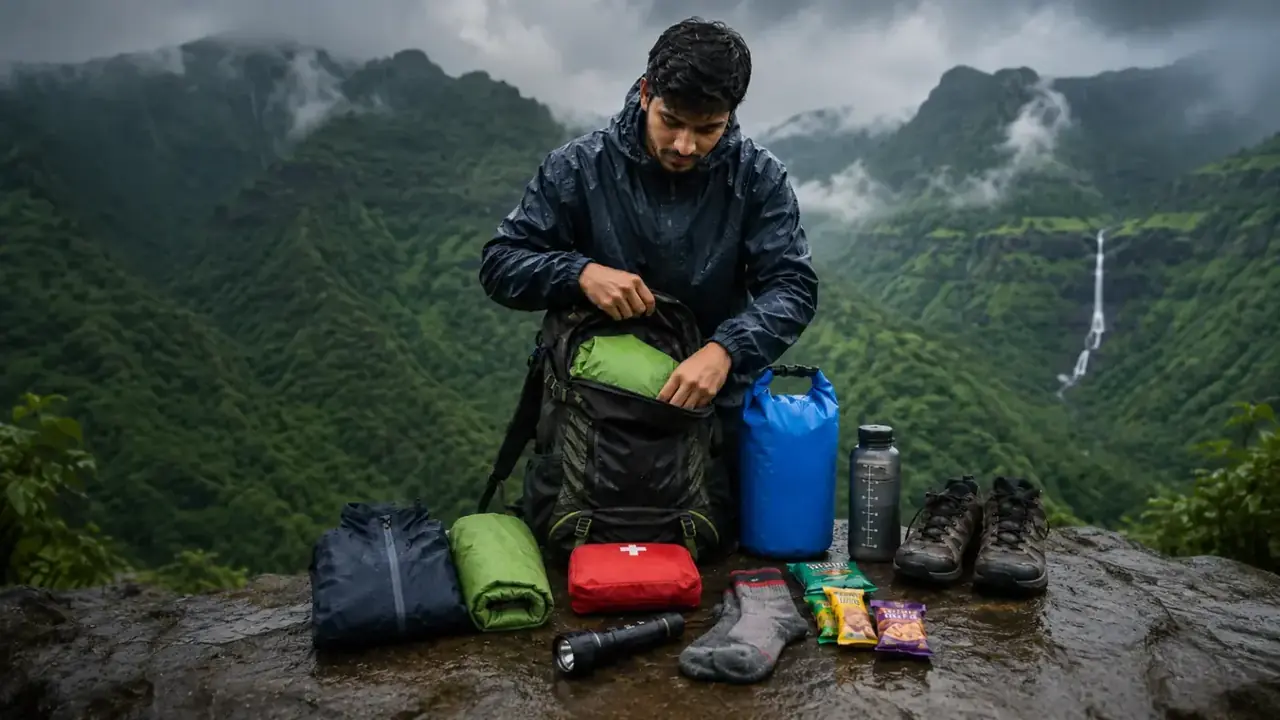
- Complete Monsoon Trek Packing List
- Leech and Insect Protection
- Common Packing Mistakes to Avoid
- Forest Department Rules and Permissions (Please Read This)
- Practical Tips from Experienced Trekkers
- Frequently Asked Questions
Why Monsoon Packing Needs a Different Approach
A backpack rain cover, the kind that comes free with most rucksacks, is designed to stop the outer fabric from soaking up water. It does very little to keep the inside dry. Water gets in through the back panel where the cover doesn't reach, through zippers, and through general internal condensation. Experienced trekkers and long-distance hikers have known this for years: a rain cover alone is not enough for sustained monsoon rain.
On top of that, Sahyadri terrain adds its own complications. Trails turn to slippery mud and laterite, stream crossings become unavoidable on several popular routes, and humidity means anything that gets wet stays wet for the rest of the day. Packing for this environment means thinking in layers, not just throwing a poncho over your bag and hoping for the best. Our monsoon trekking safety guide covers the broader precautions that go beyond just your bag.
Choosing the Right Backpack
- Size: For most Sahyadri day treks, a 20-30 liter daypack is enough. For overnight or two-day treks, 40-50 liters gives you room for a sleeping bag and extra clothing without overpacking.
- Avoid sling bags and tote bags. They throw off your balance on wet, uneven rock and rarely close well enough to keep rain out.
- Look for a bag with a rain cover built in, usually stored in a small pocket at the base. If your bag doesn't have one, buy a separate cover sized to your pack's liter capacity.
- Check the back panel and straps for padding. Wet weight sits differently on your back than dry weight, and monsoon bags tend to get heavier as the day goes on.
The Three-Layer Waterproofing System
This is the single most important section of this guide, and it's the method real backpackers and monsoon trekkers rely on, not a rain cover used alone.
Layer 1: Pack Liner (Inside the Bag) Before you put anything into your backpack, line the inside with a large, heavy-duty plastic bag. A thick garbage bag or a trash compactor bag works well and is what many experienced backpackers specifically recommend over a standard bin liner, since compactor bags are noticeably tougher and less likely to tear. Pack all your gear inside this liner, then twist the top closed before sealing your bag.
Layer 2: Dry Bags for Individual Items Inside the liner, separate your gear into smaller dry bags or thick ziplock bags by category: one for clothes, one for electronics, one for your first-aid kit. This way, even if water does get past the outer layers, only one compartment gets affected instead of everything at once. This is the same layered approach used by backpackers dealing with heavy, sustained rain on multi-day trips.
Layer 3: External Rain Cover Finally, use your backpack's rain cover (or a separately bought one) over the outside of the bag. Think of this as your first line of defense, not your only one. Combining an external cover with an internal liner is consistently more effective than relying on either method alone.
Why this matters: a rain cover keeps your bag's fabric from getting heavy with absorbed water, while the internal liner and dry bags are what actually keep your clothes, electronics, and sleeping bag dry if water does get through.
How to Pack: The Correct Order and Weight Distribution
Getting the order right isn't just about fitting everything in. It affects your balance on slippery slopes and how easily you can access things without unpacking your whole bag mid-trail.
- Bottom of the bag: Sleeping bag (in its own dry bag), spare clothes you won't need until camp, and anything soft that can double as cushioning
- Middle, close to your back: Heaviest items, like water bottles, food, and any shared group gear. Keeping heavy items close to your spine keeps your center of gravity stable on uneven, wet terrain
- Middle, away from your back: Lighter, bulkier items like your extra layer or packed lunch
- Top of the bag: Items you'll need quickly, rain poncho, first-aid kit, headlamp, snacks
- Outer pockets: Water bottle (if not using a hydration bladder), phone in a waterproof pouch, energy bars, and a small trash bag for your own litter
Complete Monsoon Trek Packing List
Clothing - Quick-dry T-shirts (avoid cotton entirely; once wet, cotton takes a long time to dry and leaves you cold) - A pair of quick-dry trekking pants or shorts - A lightweight, hooded rain poncho with sealed seams, rated for real coverage, not a flimsy plastic sheet - One extra full change of clothes, packed inside a dry bag, kept aside for after the trek or in case of emergency - A woolen cap or buff for early morning cold, plus a daytime cap for sun protection when it's not raining
Footwear - High-ankle trekking shoes with deep, grippy lugs; avoid sneakers, sandals, or smooth-soled shoes entirely - At least two pairs of spare socks, kept dry in a separate bag; wet socks for hours at a time cause blisters and discomfort - Store your shoes in their own waterproof bag when not being worn, so they don't dampen everything else in your pack
Hydration and Food - Minimum 2 liters of water per person, or a 2-3 liter hydration bladder fitted inside your pack - Light, high-calorie snacks: dry fruits, energy bars, roasted chana - ORS sachets or electrolyte powder, since humidity dehydrates you faster than you'd expect
Electronics and Documents - Phone and power bank, sealed in a dedicated waterproof pouch - A valid government ID, kept in a ziplock bag along with any cash you're carrying - A basic torch or headlamp; forest trails lose daylight faster than open terrain
First Aid and Health - Band-aids, antiseptic cream, cotton gauze, and any personal medication - Basic painkillers and blister patches - Mosquito repellent
Trek-Specific Extras - A trekking pole, genuinely useful on slippery monsoon descents - A whistle, to signal your group if visibility drops in fog - A small bag for your own trash, since carrying out everything you carry in is now standard etiquette on most Sahyadri trails
Leech and Insect Protection
Monsoon forest trails in the Sahyadris, especially routes like Andharban and other dense-canopy treks, are known for leeches. A few things genuinely help:
- Wear high-ankle shoes with your pants tucked into your socks, minimizing exposed skin at ground level
- Some trekkers use a mix of diluted antiseptic liquid (like Dettol) applied to exposed skin and footwear as a mild deterrent
- Purpose-made leech socks are available and worth carrying if you're doing a known leech-heavy route
- Check your legs and shoes periodically during breaks rather than only at the end of the trek
Common Packing Mistakes to Avoid
- Packing cotton T-shirts or jeans. Both absorb water and stay wet for hours, increasing your risk of chafing and feeling cold even in warm weather
- Relying only on an umbrella. Sahyadri monsoon winds make umbrellas nearly useless on exposed ridges; a proper hooded poncho performs far better
- Skipping the internal pack liner and trusting the external rain cover alone to keep everything dry
- Overpacking. A heavier bag is harder to balance on wet, slippery steps and rock patches
- Carrying loose electronics or cash without a waterproof pouch, a mistake that ruins phones on nearly every monsoon trek report you'll find
- Wearing new, unbroken-in shoes on trek day, which increases blister risk on long wet descents
Forest Department Rules and Permissions (Please Read This)
This is important, and it's also the part most likely to change without much notice, so treat everything here as a starting point, not a final answer.
- Several popular Sahyadri routes require forest department permits, sometimes with a daily visitor cap. Andharban, for example, has been reported to allow only a limited number of trekkers per day with mandatory online registration and a Forest Department-approved guide.
- Entry timing restrictions are common during monsoon. Rules like "no entry after 3 PM" have been enforced at several trekking spots in recent seasons to reduce accident risk.
- Some locations have seen temporary monsoon entry bans in past years, sometimes lasting until early August, due to overcrowding or safety concerns following past incidents.
- Popular routes like Harihar Fort have reportedly faced monsoon weekend restrictions specifically because of overcrowding on narrow, exposed sections like its rock-cut staircase.
Disclaimer: Forest department rules, permit requirements, entry caps, and timing restrictions for Sahyadri treks change frequently and are often announced close to or during the monsoon season itself. Please verify current rules directly with the relevant Forest Division, your trek organizer, or official Maharashtra tourism sources before you leave, rather than relying solely on any blog, including this one.
Practical Tips from Experienced Trekkers
- Pack the night before, not the morning of, so you have time to actually test your waterproofing layers
- Do a trial pack at home and carry the loaded bag around your house for ten minutes; if a strap digs in or the balance feels off, adjust before trek day
- Keep your rain poncho and first-aid kit in the same easy-access pocket every time, so you're not fumbling for them when it starts pouring
- Inform someone at home about your route and expected return time before you leave, especially for treks in remote or low-network areas
- If trekking with a group or organizer, ask in advance whether river crossings are part of the route, and pack accordingly
Frequently Asked Questions
1. Is a rain cover enough to keep my backpack dry during a Sahyadri monsoon trek? No, not on its own. A rain cover protects the outer fabric but doesn't fully stop water from getting inside through the back panel, zippers, and seams. Combining it with an internal pack liner and dry bags for individual items is significantly more effective.
2. What size backpack is ideal for a Sahyadri monsoon day trek? A 20-30 liter daypack is generally sufficient for a single-day trek. For overnight or multi-day treks, 40-50 liters gives enough room for a sleeping bag and extra clothing.
3. Should I carry an umbrella or a rain poncho on a monsoon trek? A hooded rain poncho with sealed seams is far more practical than an umbrella, especially on exposed ridges where Sahyadri monsoon winds make umbrellas difficult to use.
4. How do I protect my phone and electronics from rain while trekking? Use a dedicated waterproof pouch for your phone and power bank, and keep them inside your pack's inner dry bag layer, not just in an outer pocket.
5. What clothing should I avoid packing for a monsoon trek? Avoid cotton T-shirts and denim. Both absorb water, take a long time to dry, and leave you cold and uncomfortable once wet. Quick-dry fabrics are the better choice.
6. Do I need a forest department permit for Sahyadri monsoon treks? It depends on the specific trail. Some routes, like Andharban, require mandatory permits with daily visitor caps, while others don't. Since these rules change often, always confirm directly with the relevant forest division or your trek organizer before your trip.
7. How do I deal with leeches on monsoon forest treks? Wear high-ankle shoes with pants tucked into your socks, consider leech socks on known leech-heavy routes, and check your legs periodically during the trek rather than only at the end.
A well-packed bag doesn't just keep your gear dry, it changes how much you actually enjoy the trek itself. The difference between a miserable, soggy climb and a genuinely memorable monsoon trek in the Sahyadris often comes down to a garbage bag liner, a couple of dry bags, and ten extra minutes of packing the night before.
Layer your waterproofing, pack heavy items close to your back, avoid cotton, and always check current forest department rules before you leave. Do that, and the rain becomes part of what makes the Sahyadri monsoon trek worth doing, not the thing that ruins it.
Ready for Your Next Adventure?
Don't just read about it — come experience it. Book your spot on our Monsoon Special Treks with certified trek leaders, small groups, and everything organised for you.
🏷 how to pack a backpack for monsoon trek, monsoon trekking packing list Maharashtra, Sahyadri trek backpack waterproofing, rain cover vs dry bag trekking
Be the first to comment on this post.