Introduction
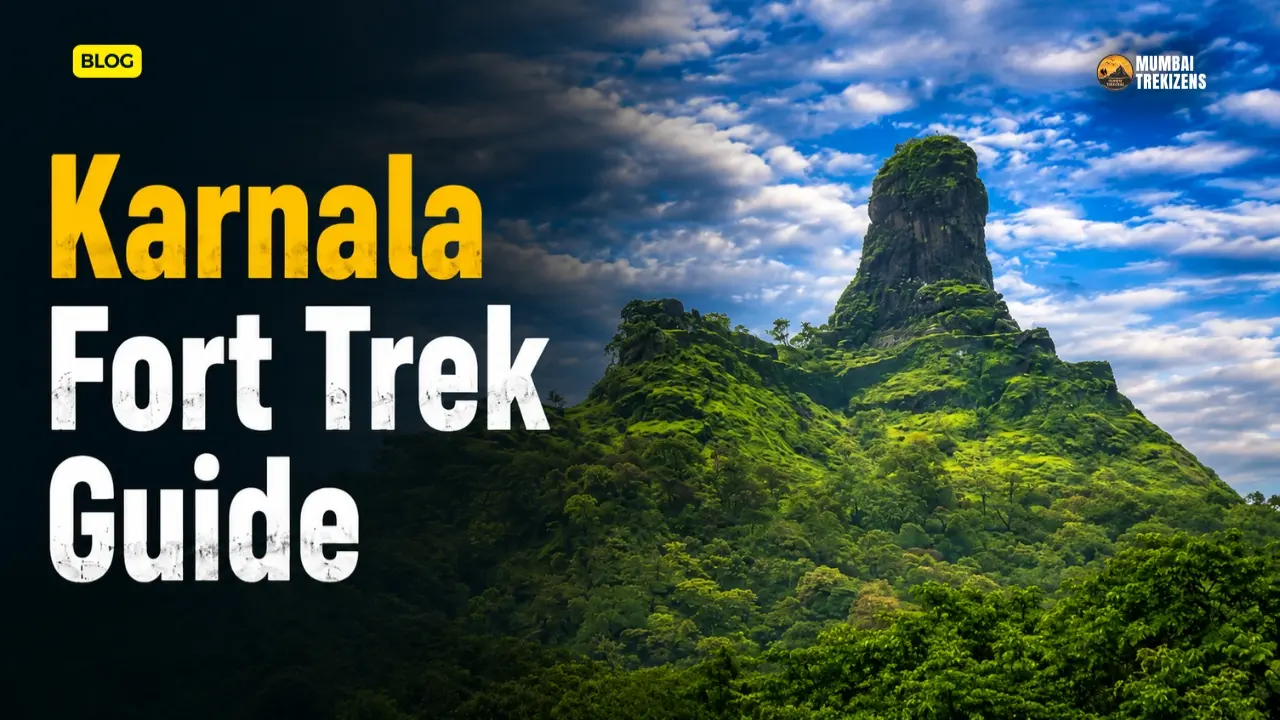
You have already seen it. Anyone who has driven the Mumbai-Goa highway past Panvel has looked up and seen a blunt stone thumb sticking out of a wooded hill. That thumb is the reason the Karnala Fort trek exists as a weekend habit for half of Navi Mumbai.
The fort sits at roughly 445 metres above sea level in Panvel taluka, Raigad district, and it comes with something no other Sahyadri fort trek has: a ticket counter run by the Forest Department, and 12.11 square kilometres of protected forest around it. Karnala Bird Sanctuary was Maharashtra's first bird sanctuary, notified in 1968.
That changes the whole character of the trek. There are timings. There is a closed day. There are marked trails with resting sheds, clean toilets at the base, and iron railings on the last climb. There is also a strict plastic policy and a silence rule, and the Forest Department enforces both.
So this is not a wilderness trek. It is a very good, very accessible half-day out that happens to include a 13th-century-era hill fort, over two hundred recorded bird species, and one pinnacle you should absolutely not try to climb.
Table of Contents
- Quick Overview
- Entry Fees, Timings and the Closed Day
- Where Karnala Is
- The Sanctuary: Maharashtra's First
- History of Karnala Fort
- Pandu's Tower — The Thumb
- The Four Trails and the Fort Track
- Difficulty Level
- How to Reach Karnala
- Suggested Itinerary
- Sanctuary Rules You Must Follow
- Accommodation
- Food and Water
- Nearby Attractions
- Budget Breakdown
- Practical Tips
- Safety Tips
- Common Mistakes
- Best Time to Visit
- Frequently Asked Questions
- Conclusion and Call-to-Action
Quick Overview
| Detail | Information |
|---|---|
| Location | Karnala, Panvel taluka, Raigad district, on NH 66 (Mumbai-Goa highway) |
| Fort height | Approximately 445 m (about 1,440 ft) above sea level |
| Sanctuary area | 12.11 sq km |
| Established | 1968, Maharashtra's first bird sanctuary |
| Distance from Panvel | Approximately 12 km |
| Distance from Mumbai | Approximately 50-55 km |
| Distance from Pune | Approximately 120 km |
| Fort trek | Roughly 4-6 km round trip; about 90 minutes each way on the fort track |
| Total time on site | 2-3 hours for the trek, add an hour or two for the nature trails |
| Difficulty | Easy to moderate |
| Entry fee | ₹60 per Indian adult (see full table below) |
| Timings | Gate opens 7:00 am, last entry 4:00 pm, closes 5:30 pm |
| Closed | Mondays |
| Nearest railhead | Panvel |
Entry Fees, Timings and the Closed Day
This is the part people get wrong, so here it is in full, as published by the sanctuary.
Entry and visitor fees
| Item | Indian nationals | Foreign nationals |
|---|---|---|
| Adult entry | ₹60 | ₹120 |
| Child entry (5-12 years) | ₹30 | ₹60 |
| Still camera | ₹195 | ₹390 |
| Video camera | ₹490 | ₹975 |
Parking
| Vehicle | Fee |
|---|---|
| Two-wheeler | ₹50 |
| Light vehicle (car) | ₹195 |
| Heavy vehicle (bus) | ₹295 |
Yes, car parking costs more than three entry tickets. That has annoyed a lot of visitors and it is the correct rate. Come on a bike or share a car.
Mobile phone photography is not charged separately. A dedicated still camera is.
Timings
- Gate opens: 7:00 am
- Last entry permitted: 4:00 pm
- Sanctuary closes: 5:30 pm
- Closed on: Monday
Do not turn up at 4:30 pm expecting a quick walk. You will be turned away.
Payment and booking
Entry fees are paid at the Forest Department gate. The sanctuary also operates an online booking portal at booking.karnalabirdsanctuary.org. Carry a valid government photo ID; the sanctuary asks for it at verification, and if you have booked online, carry a printed receipt.
Fees and timings change. The figures above are as listed by the sanctuary's own published fee schedule at the time of writing, and they match what visitors were paying at the gate through late 2025 and 2026. Confirm before travelling if the exact number matters to your budget.
Where Karnala Is
Karnala sits in Panvel taluka of Raigad district, directly on the Mumbai-Goa national highway, NH 66. The gate is on the highway itself, which is why this is the single most accessible protected forest in the Mumbai region. Roughly 12 km from Panvel. About 50 to 55 km from Mumbai. Around 120 km from Pune.
Durgbharari places the approach near Shirdhon village, with the sanctuary at the fort's base directly opposite. The fort was strategically important because it overlooked the Bor pass, the route linking the Konkan coast to the Deccan plateau — the main trade artery between the two.
From the top you can pick out Prabalgad, Manikgad, Haji Malang, Chanderi, Matheran, Sankshi, Dronagiri and Rajmachi on a clear winter morning. Panvel city sits below in plain view. If you have already done the Prabalgad fort trek, you will recognise the plateau shape immediately.
The Sanctuary: Maharashtra's First
Karnala Bird Sanctuary covers 12.11 square kilometres and was established in 1968, making it the first bird sanctuary in the state. Along with Sanjay Gandhi National Park and Tungareshwar, it is one of very few protected areas genuinely within a Mumbai day-trip radius.
The numbers are worth knowing before you go, because they set expectations properly.
Over 222 bird species have been recorded here. Of those, 161 are resident, 46 winter migrants, three breeding migrants, seven passage migrants and five vagrant. Eight Western Ghats endemics have been found at Karnala: Grey-fronted Green-pigeon, Nilgiri Woodpigeon, Malabar (Blue-winged) Parakeet, Malabar Grey Hornbill, White-cheeked Barbet, Malabar Lark, Small Sunbird and Vigor's Sunbird.
Five genuinely rare birds have been sighted: ashy minivet, three-toed kingfisher, Malabar trogon, Slaty-legged Crake and Rufous-bellied Eagle. The sanctuary qualifies as an Important Bird Area, meeting both the globally threatened species and restricted-range species criteria.
There are also 114 butterfly species on record, including the very large Blue Mormon.
Here is the honest bit. Those are cumulative records built over decades of surveys, not what you will see on a Sunday. The sanctuary's own site currently highlights "123+ bird species" and "56+ butterfly species" as its headline figures. Turn up at 10 am on a weekend with a group talking loudly and you will see langurs and bulbuls. Turn up at the 7 am gate opening on a Wednesday in January, walk the Hariyali trail slowly and quietly, and the numbers start to mean something.
Leopards use this forest. Sightings near the sanctuary were reported in 2016 and put trekkers and villagers on alert. That is normal for Konkan forest edges and not a reason to stay away, but it is a reason to stay on the trail and not walk it alone at dusk.
History of Karnala Fort
Karnala is also called Funnel Hill in the colonial record. The fort was likely constructed before 1400. Under the Devagiri Yadavas (1248-1318) and then the Tughlaq rulers (1318-1347), Karnala served as the capital of the north Konkan districts — that is, roughly modern Thane and Raigad.
Then it changes hands repeatedly, and the sequence is unusually well documented:
- It came under the Gujarat Sultanate, then in 1540 was taken by Nizam Shah of Ahmednagar.
- The Gujarat sultans asked the Portuguese at Bassein (Vasai) for help. Dom Francisco de Menenzes sent 500 soldiers, who captured it. The fort stayed nominally with the Gujarat Sultanate but with Portuguese garrisons.
- Nizam Shah sent 5,000 men to retake it. They failed. But the Portuguese viceroy decided Karnala had little strategic value and returned it to Nizam Shah for an annual payment — recorded as Rs. 17,500, or 5,000 gold Pardoas.
- Chhatrapati Shivaji Maharaj conquered it from the Mughals in 1670, advancing by building breastworks as he went. Durgbharari's account adds that the Maratha army, having reached the fort's base behind those mud barriers, entered using ropes shaped into ladders.
- Karnala was among the twenty-three forts ceded to the Mughals in the Treaty of Purandar. After Shivaji's death in 1680 it passed to Aurangzeb.
- With the rise of the Peshwas it came to them in 1740, held by killedar Anantrao. Durgbharari identifies him as Anantrao Phadke, grandfather of the revolutionary Vasudev Balwant Phadke.
- Colonel Prother took the fort for the British East India Company in 1818. Durgbharari records the garrison holding out against the British for three days.
Two inscriptions survive, or survived. A Marathi inscription on the inner side of the lower gate, undated, its words largely indecipherable. And a Persian inscription on the upper gate reading "Syed Nuruddin Muhammad Khan, Hijri 1147 AH (1735 CE)", probably from the Mughal occupation. Wikipedia notes this rock-cut inscription was removed by miscreants some time ago.
At the base of the fort there is a temple to the goddess Bhavani. Durgbharari also records a domed Karnai Devi temple with a black stone idol on the plateau below the fort gate.
A cultural footnote worth having: G.N. Dandekar's Marathi novel Jait Re Jait is set against Karnala, and the film of the same name was shot in this area.
Pandu's Tower — The Thumb
The thing you see from the highway is the citadel. Karnala consists of two forts, one at a higher level and one lower, and at the centre of the higher one stands a basalt pillar recorded at 125 feet high. It is also called Pandu's Tower.
Durgbharari describes the pinnacle as roughly 100 feet. Sources differ on the number. The shape does not: a blunt vertical column of rock, standing alone, visible from kilometres away on the highway.
It was used as a watchtower when the fort was garrisoned. It is now ruined.
Do not climb it. Two reasons, both serious. First, technically it needs mountaineering equipment and real rock-climbing competence — this is not a scramble. Second, and this is the part people ignore, the pinnacle is covered in beehives. Wikipedia records that the bee presence has resulted in at least one casualty in recent times.
Related and practical: do not cook or light a fire at the base of the pinnacle. The smell of smoke irritates the bees. This is not a soft suggestion, it is documented advice, and cooking is prohibited inside the sanctuary anyway.
Around the pinnacle's base there are large rock-cut water cisterns and caves cut into the rock, with fort ramparts visible in a ring. Behind the pinnacle, another small hill connects to the fort hill by a narrow neck; this western section has some flat ground and the best-preserved remains on the fort, including two gateways with carving on either side of one.
The Four Trails and the Fort Track
This is the useful stuff. Karnala has marked trails of different lengths, and most people walk the fort track without realising the others exist.
| No. | Trail | Length | Approximate time |
|---|---|---|---|
| 1 | Hariyali Nature Trail | 1 km | 30 minutes |
| 2 | Garmal Nature Trail | 3 km | 90 minutes |
| 3 | Mortaka Nature Trail | 5 km | 150 minutes |
| 4 | Track to Karnala Fort | 5 km | 90 minutes |
| 5 | Approach road to Rest House and adjoining area | 0.5 km | 15 minutes |
The sanctuary lists the Hariyali trail as the one to walk for birds, with a chance at the Paradise Flycatcher.
For the fort itself there are effectively two ways up. The main Karnala fort trail, which Wikipedia measures at 2.69 km from the bottom of the hill and about an hour of walking. And a nature trail approach, shorter at 1.20 km but steeper. The sanctuary's own listing puts the fort track at 5 km and 90 minutes, and the total round trip at 4 to 6 km with 2 to 3 hours of walking. The discrepancy is about where you start measuring from — the highway gate, or the trailhead after the internal approach road.
Practically: from the gate to the summit and back, block out three hours and you will not be rushed.
On the way up there are five resting places built by the Forest Department. The final climbing steps near the fort entrance have been made safe with iron railings, and there is an iron ladder at one point on the approach to the second gate. Three gates in total before you are properly inside the fort.
The fort head runs south to north. The ramparts up there have largely collapsed. In front of the gate is the Bhavani Mata temple, and beside it a wrought-stone structure still standing with its walls intact. A Shivling sits open a short distance ahead.
Wikipedia notes that the southernmost rock-cut water cistern on the fort holds potable water, and that first aid is available at the forest guest house. Both are useful to know and neither is a substitute for carrying your own supplies.
Difficulty Level
Easy to moderate. That is the sanctuary's own grading and it is honest.
The path is clearly visible throughout — Durgbharari calls the climb steep and tiring, which is fair, but there is no route-finding problem and no exposure. Iron railings handle the only genuinely awkward section near the top. Regular walkers reach the summit inside 60 to 90 minutes.
Where it catches people out:
- The gradient is relentless in the middle third. No flat recovery sections. It is a steady grind rather than a series of steps.
- There is no water source on the trail. Not one, until the summit cistern.
- After 10 am from February onward the heat is a real factor despite the tree cover.
- Some short boulder sections need hands, particularly on descent.
Good for children over about eight who walk regularly. Good for a genuine first fort trek. If this is your first, read the Sahyadri trekking safety checklist for beginners first.
How to Reach Karnala
From Mumbai
Harbour line local to Panvel. Panvel is the nearest railhead and everything else runs from there.
From Panvel station: - ST buses from Panvel bus stand serve the sanctuary. Wikipedia's entry records regular buses at roughly 30-minute intervals from Panvel bus stand between 5:00 am and 8:00 pm. The sanctuary confirms ST buses and shared cabs from Panvel station reach the sanctuary entrance. - Auto rickshaw from Panvel directly to the sanctuary gate. Quick, and the standard choice for a group of three. - Own vehicle: NH 66 southbound out of Panvel, the gate is on the highway. Roughly 50 to 55 km from central Mumbai.
Total Mumbai to gate: about 2 to 2.5 hours by public transport, 1.5 hours by car outside peak traffic.
From Pune
Roughly 120 km. Expressway to Khopoli, then across to NH 66 and north toward Panvel. About 2.5 hours by car. By bus, Pune to Panvel and then local transport, which makes it a long day for a 90-minute trek — reasonable only if you are combining it with something else.
From Navi Mumbai
Twenty to thirty minutes from Kharghar or Panvel by road. This is a genuine before-lunch outing if you live here.
Aim to be at the gate at 7:00 am. Not 9. The difference in heat, crowd and bird activity between 7 am and 9 am on this trek is enormous.
Suggested Itinerary
Half-day, from Mumbai, own vehicle
- 5:15 am — leave Mumbai
- 6:50 am — reach Karnala gate, park, buy tickets
- 7:00 am — gate opens, walk the internal approach road
- 7:15 am — start the fort track
- 8:30 am — summit. Bhavani temple, ramparts, Pandu's Tower from a safe distance, the western section and its gateways
- 9:15 am — begin descent
- 10:15 am — back at the base
- 10:30 am — walk the Hariyali nature trail for birds, one kilometre, thirty minutes
- 11:15 am — breakfast at one of the base eateries
- 12:00 pm — leave
If you want birds more than the fort: flip it. Hariyali and Garmal trails first thing at 7 am when the birds are active, fort afterwards. You will trek in more heat, but the birding is far better.
Sanctuary Rules You Must Follow
These are the Forest Department's rules for the sanctuary, and they are enforced.
- Plastic-free zone. Karnala is strictly plastic-free. Avoid disposable plastic bottles and wrappers. Violators face heavy penalties. The gate staff check bottles at entry and some visitors have reported a returnable deposit system for bottles taken in.
- Maintain silence. Speakers and loud music are prohibited. This one gets broken constantly by weekend groups and it is precisely why they see no birds.
- No feeding any bird or animal. Human food is harmful and it makes monkeys aggressive. More on this in our wildlife safety on Sahyadri treks guide.
- Stay on the designated trails — Hariyal, Mortaka, Gaarmaal, or the main fort path. Going off-trail is dangerous and damages the ecosystem.
- No flash photography and no drones.
- No smoking, no alcohol, no weapons, no flammable material.
- Carry government photo ID and, if you booked online, a printed receipt.
- Park only in designated areas.
The Forest Department's notice is explicit that it is not responsible for personal accidents or loss of belongings. Behave accordingly.
Accommodation
Karnala is a day trip. Nobody needs to stay overnight for a 90-minute trek. But if you want to:
- Two government rest houses exist inside the sanctuary area. These are Forest Department properties, and availability has to be arranged through the department, not booked casually online.
- Hotels and resorts line the highway near the sanctuary. There is a spread of options within a few kilometres on NH 66, from basic highway lodges to resort-style properties with pools aimed at Mumbai weekenders.
- Panvel has plenty of ordinary hotels if you want an early start without a 4 am wake-up.
There is no camping on the fort. It is a protected sanctuary. Do not try.
Food and Water
On the trail: nothing. No stalls, no water, no shops. This is worth repeating because Karnala's easy reputation makes people casual about it.
At the base: there are eateries near the gate serving snacks and lunch at reasonable prices, and clean washrooms distributed around the sanctuary base area. Post-trek poha and tea is the standard ritual.
Water: carry a minimum of 2 litres per person, which is what the sanctuary itself specifies. Three if you are going after February. The summit's southernmost rock-cut cistern is recorded as potable, but the other tanks on the fort are not, several look stagnant, and you should not be swimming in or drinking from them casually.
Because Karnala is a strict plastic-free zone, bring a reusable bottle. Fill it before the gate.
Nearby Attractions
- Prabalgad and Kalavantin Durg. North of Karnala on the same Panvel axis, and visible from the summit. Both need a full day, not a half. See the Prabalgad fort trek guide and the Kalavantin Durg trek guide.
- Panvel. Not a tourist town, but the practical hub for everything here.
- Matheran. Visible from the top, reached separately via Neral.
- Manikgad and Sankshi forts. Both visible from Karnala's summit, both quieter and rougher than Karnala.
- Pali and the Ballaleshwar temple. Further south on the Konkan side, and the anchor for the Sudhagad fort trek if you want to make a longer weekend of the district.
Budget Breakdown
Per person, from Mumbai, half day.
| Item | Cost (INR) |
|---|---|
| Mumbai to Panvel local train (return) | 40 - 80 |
| Panvel to Karnala gate, ST bus or shared auto (return) | 60 - 150 |
| Sanctuary entry, Indian adult | 60 |
| Still camera, if you carry one | 195 |
| Breakfast or lunch at the base | 100 - 200 |
| Water and snacks carried in | 60 - 100 |
| Total per head, public transport, no camera fee | approximately 320 - 590 |
By car, two people sharing:
| Item | Cost (INR) |
|---|---|
| Fuel and tolls, Mumbai return | 700 - 1,100 total |
| Car parking at the sanctuary | 195 |
| Entry, two adults | 120 |
| Food | 300 - 400 |
| Total for two | approximately 1,300 - 1,800 |
Karnala is one of the cheapest trekking days available near Mumbai. The car parking fee is the one line item that surprises people.
Practical Tips
- Be at the gate for the 7:00 am opening. This single decision improves everything: temperature, crowds, bird activity, parking.
- Never plan Karnala for a Monday. The sanctuary is closed.
- Go by two-wheeler or share a car. Bike parking is ₹50 against ₹195 for a car.
- Leave the DSLR at home unless you will use it, or budget the ₹195 still camera fee. Phone photography is free.
- Reusable bottle, not disposable. Plastic-free zone, enforced with penalties.
- Carry cash for entry and parking, even though online booking exists.
- Silence pays. The difference between a quiet pair on the Hariyali trail and a group with a Bluetooth speaker is the difference between seeing thirty species and seeing three.
- Grippy shoes for the descent. The boulder sections are where ankles go. Our trekking footwear guide for Sahyadri terrain covers what actually works on Konkan basalt.
- Note where the forest guest house is on the way in. First aid is available there.
Safety Tips
- Do not climb Pandu's Tower. The pinnacle requires climbing equipment and technique, and it is covered in beehives. At least one death has been recorded there in recent times.
- Do not light fires or cook anywhere near the pinnacle base. Smoke provokes the bees. Cooking is prohibited in the sanctuary regardless.
- If bees start rising, move downhill and away, quietly. Do not swat, do not run uphill, cover your head and neck.
- Monkeys and langurs are habituated and bold. Keep your bag closed and do not eat in the open on the trail.
- Leopards use this forest. Sightings near the sanctuary have been reported. Stay on the trails, walk in company, and do not be on the hill near dusk.
- Snakes shelter in rock gaps on the summit ruins. Do not put hands into crevices you cannot see into.
- The descent is where the injuries happen, not the climb. Slow down on the boulder steps.
- Skip this trek in heavy rain. The trail turns slippery and the iron ladder and railings are wet metal. Read our monsoon trekking safety guide for the Sahyadri if you are going in July.
- Carry a basic kit. The first aid kit for Sahyadri treks list covers a trek of this length in under 400 grams.
Common Mistakes
- Driving out on a Monday. Closed. Every time.
- Arriving after 4:00 pm and being refused entry.
- Carrying no water because the trek is "only an hour". There is nothing on the trail.
- Playing music. Against the rules, and it destroys the entire point of a bird sanctuary.
- Trying to scramble up the pinnacle for a photo.
- Bringing disposable plastic bottles into a plastic-free zone.
- Expecting to see 222 bird species. That is the cumulative record. Come at 7 am, quiet, in winter, and you will do well.
- Feeding the monkeys, which is how a nice trek turns into a bag-snatching incident.
Best Time to Visit
November to February is the answer for both the fort and the birds.
- November to February: the clear best window. Cool mornings, dry rock, good visibility to Prabalgad and Matheran, and this is when the 46 winter migrant species are present. If birds are why you are going, come now.
- October: still green from the monsoon, pleasant, slightly humid. Very good.
- March: acceptable at 7 am. Unpleasant by 10.
- April and May: skip it, or do only the short Hariyali trail early. The fort track in Konkan pre-monsoon heat with no water on the trail is a bad idea, and there is nothing at the top worth suffering for. Several visitors specifically warn about the heat draining you on the descent.
- June to September: monsoon Karnala is genuinely beautiful and it is one of the more popular wet-season walks near Mumbai. But the trail is slippery, leeches appear, and the summit view is usually a wall of cloud. Do the nature trails rather than the fort track if it has been raining hard. Raigad district has also imposed prohibitory orders restricting access to certain forts and waterfalls during peak rainfall in recent years, so check the district notification if you are planning a July or August trip.
Best time of day, any season: the 7:00 am gate opening. Not negotiable if you want the good version of this trek.
Frequently Asked Questions
1. What is the entry fee for Karnala Bird Sanctuary? As published by the sanctuary, ₹60 per adult and ₹30 per child aged 5 to 12 for Indian nationals; ₹120 and ₹60 for foreign nationals. A still camera costs ₹195 and a video camera ₹490. Parking is ₹50 for a two-wheeler, ₹195 for a car and ₹295 for a bus. Fees are paid at the Forest Department gate. Verify before travelling as rates change.
2. What are Karnala Bird Sanctuary timings, and is it open on Monday? The gate opens at 7:00 am, last entry is permitted at 4:00 pm, and the sanctuary closes at 5:30 pm. It is closed on Mondays.
3. How difficult is the Karnala Fort trek? Easy to moderate. The path is clear throughout with no route-finding problem, the Forest Department has built five resting places on the way, and the final steps near the fort entrance have iron railings. The climb is steep and steady with no flat recovery sections, and there is no water source on the trail. Most walkers reach the top in 60 to 90 minutes.
4. How high is Karnala Fort and how long is the trek? The fort sits at approximately 445 metres, about 1,440 feet, above sea level. The sanctuary lists the fort track at 5 km and 90 minutes, with a total round trip of 4 to 6 km and 2 to 3 hours of walking. Wikipedia measures the fort trail at 2.69 km from the bottom of the hill, about an hour, with a shorter and steeper 1.20 km nature-trail approach.
5. What is Pandu's Tower at Karnala? It is the thumb-shaped basalt pillar at the centre of the upper fort, recorded at 125 feet high, used as a watchtower when the fort was garrisoned and now ruined. It is the feature visible from the Mumbai-Goa highway. It should not be climbed: it needs mountaineering equipment and it is covered in beehives, with at least one death recorded there in recent times.
6. How do I reach Karnala Fort from Mumbai without a car? Take a Harbour line local to Panvel, then an ST bus or shared auto from Panvel bus stand or station to the sanctuary gate on NH 66. Buses from Panvel bus stand run at roughly 30-minute intervals from early morning. The gate is directly on the highway, roughly 12 km from Panvel.
7. Can I see many birds at Karnala? Over 222 species have been recorded cumulatively, including 46 winter migrants and eight Western Ghats endemics, plus 114 butterfly species. What you actually see depends entirely on timing and behaviour. Arrive at the 7:00 am opening in winter, walk the 1 km Hariyali trail slowly, and keep silent. The sanctuary specifically recommends Hariyali for a chance at the Paradise Flycatcher.
8. Is Karnala Fort trek safe for children? Yes, for children over roughly eight who walk regularly. It is short, clearly marked, has resting sheds and railings on the awkward section. Keep them well clear of the pinnacle base because of the beehives, keep snacks packed away because of the monkeys, and carry enough water since there is none on the trail.
Karnala does two things at once, which is unusual. It is a legitimate hill fort with a documented seven-century record — Yadava capital, Portuguese garrison, Shivaji's 1670 breastworks assault, Peshwa killedar, British surrender in 1818, with a Persian inscription dated 1735 CE on the upper gate. And it is Maharashtra's first bird sanctuary, 12.11 square kilometres of protected Konkan forest with a genuinely rich species list.
The version of this trek most people do — 10 am arrival, Bluetooth speaker, no water, straight up and straight down — is a wasted morning. The version that works costs the same ₹60. Be at the gate at 7. Stay quiet. Walk Hariyali as well as the fort track. Look at Pandu's Tower from a distance and leave the bees alone.
Then go home for lunch, because that is the other good thing about Karnala.
Ready for Your Next Adventure?
Don't just read about it — come experience it. Explore our upcoming treks, camps and tours, all run with certified leaders and small groups.
🏷 - Karnala Bird Sanctuary entry fee, - Karnala Fort trek timings, - Pandu's Tower Karnala, - Karnala nature trail, - Karnala fort trek from Panvel, - Karnala Bird Sanctuary entry fee and timings 2026, - how to reach Karnala Fort from Mumbai by train, - Karnala Fort trek difficulty for beginners with kids, - is Karnala Bird Sanctuary closed on Monday, - best time to visit Karnala Bird Sanctuary for birdwatching
Be the first to comment on this post.