Introduction
Learning how to remove a leech while trekking is a rite of passage for anyone who walks the Western Ghats in July. And almost everyone learns it wrong, from a senior on their first trek, holding a lighter to their own ankle.
Here is the short version, and you can stop reading after this paragraph if a leech is on you right now. Do not use salt. Do not use fire. Do not use kerosene, tobacco, Dettol, alcohol, vinegar, lemon or insect repellent on an attached leech. All of those make the animal vomit the contents of its gut into your open wound before it lets go, and that is where infections come from. Slide a fingernail or the edge of a card flat against your skin, under the small end first, then the big end, and flick it away.
Now the longer version. Leeches are not dangerous. They are a nuisance with a very good PR problem, and the actual medical risks are secondary infection, prolonged bleeding in people on blood thinners, and, in one weird category, a leech that gets somewhere it should not be. Everything else is squeamishness, and squeamishness is what makes people reach for the lighter.
This is general safety guidance for trekkers, not a substitute for professional medical care. An infected wound needs a doctor.
Table of Contents
- What You Are Actually Dealing With
- Where and When Leeches Hit
- How a Leech Finds You and Gets In
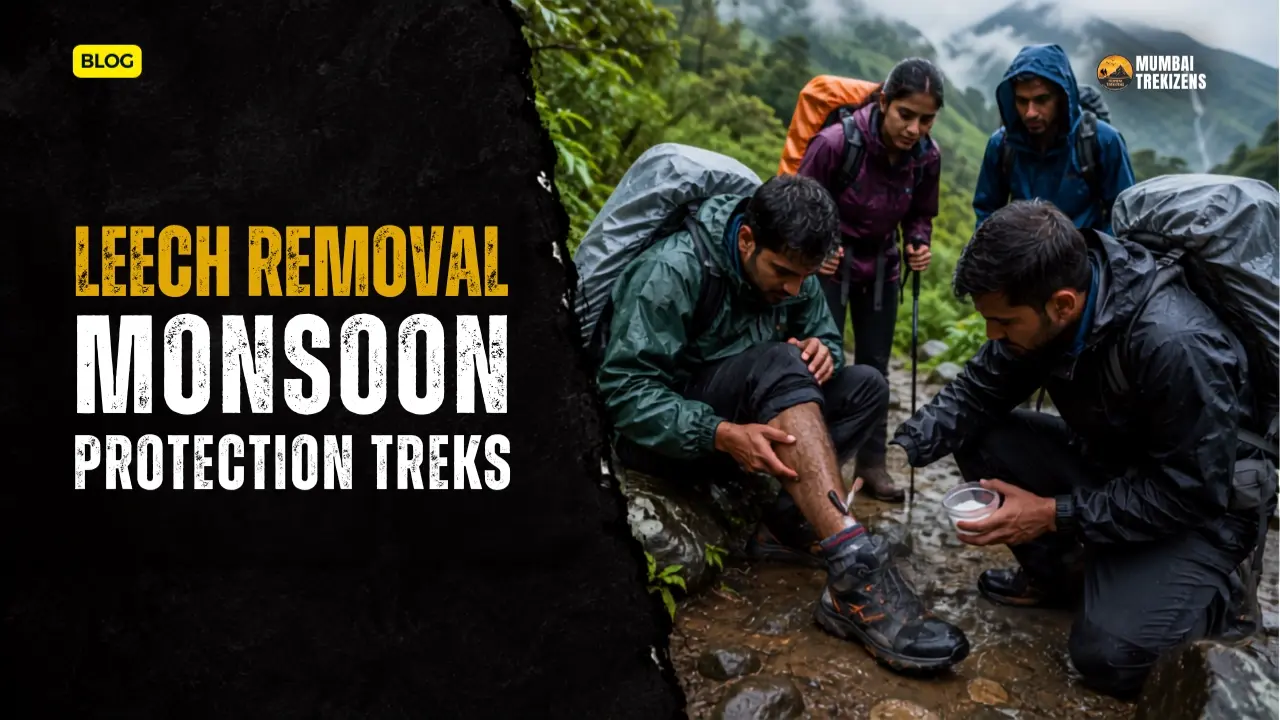
- The Correct Removal Method
- The Myths: Salt, Fire, Kerosene, Tobacco, Dettol
- Why the Bite Bleeds for Hours
- After Removal: Wound Care That Prevents Trouble
- When a Leech Bite Actually Needs a Doctor
- Leeches in the Nose, Throat and Eye
- Prevention: Leech Socks, Repellents and the Dettol Cloth Trick
- Clothing and Footwear Strategy
- Common Mistakes
- Seasonal Risk Through the Year
- Emergency Contacts
- Frequently Asked Questions
What You Are Actually Dealing With
The animal on your ankle is a land leech, genus Haemadipsa, family Haemadipsidae. Terrestrial, not aquatic. It lives in damp leaf litter, on wet undergrowth, on mossy rock and along shaded trail edges.
Several species occur across the Indian humid forest belt. Haemadipsa zeylanica is recorded from the Western Ghats, including a subspecies described from the Nilgiris and one endemic to India with its type locality at Cochin. Haemadipsa sylvestris is documented in southern India and the Western Ghats. You do not need to tell them apart. They all behave identically as far as your ankle is concerned.
Physically, a land leech is a segmented worm with a sucker at each end. The small anterior sucker at the head end contains three jaws that make a neat Y-shaped or triradiate cut. The large posterior sucker is the anchor. They inchworm along, they can climb, and they are much faster than their reputation suggests. They hold about five times their body weight in blood and then drop off, typically after 20 to 60 minutes of feeding.
The important biology: a leech has no venom. It has an anticoagulant, hirudin, plus a local anaesthetic that is why you never feel the bite, plus a vasodilator. And it has a gut full of symbiotic bacteria, notably Aeromonas hydrophila, which is the actual medical problem.
Where and When Leeches Hit
The Sahyadris in monsoon. Bhimashankar, Rajmachi's forest section, the Matheran ravines, the Amba Ghat and Radhanagari belt, Kalsubai's forest lower half, the Tamhini and Mulshi trails, Kaas and Koyna approaches, Harishchandragad's Nalichi Vaat and Pachnai forest stretches. Anywhere in the Ghats with tree cover and standing wet leaf litter, from roughly mid-June to late September.
The southern Western Ghats. This is where it gets serious. Wayanad, Coorg, Agumbe, Kudremukh, Silent Valley, the Anamalais, the Nilgiris. Agumbe and Kudremukh in July will put more leeches on you in an hour than the entire Sahyadri season.
The North East. Meghalaya, especially the Cherrapunji and Mawlynnong belt, Arunachal, Nagaland, Sikkim's lower forests, the Assam foothills. Meghalaya's rainfall does what you would expect.
Himalayan foothills. Below roughly 2,000 to 2,500 m in the wet outer ranges during and after the monsoon, particularly on the Uttarakhand and Himachal forest approaches and throughout eastern Nepal-adjacent Sikkim. Above the tree line, none.
Time of day matters less than you would think, but activity peaks in humid overcast conditions and after rain. A hot dry spell shuts them down. The first heavy rain of June switches them on like a light.
How a Leech Finds You and Gets In
Haemadipsa detects vibration, shadow, exhaled carbon dioxide, body heat and possibly skin chemistry. When a group walks a trail, leeches on the surrounding vegetation orient toward it and start moving. The person at the back of the line usually gets the most, because the front of the line has woken everything up.
Entry points, in descending order of how often trekkers actually get bitten:
- Over the top of the shoe, through the sock, at the ankle
- Through the shoe's mesh or lace holes
- Up the inside of the trouser leg
- From vegetation brushing the calf or knee
- From a hand on a wet branch or trunk, then up the sleeve
- From sitting down on leaf litter or a mossy rock for a break
- Under the waistband and belt line, which is where people find them hours later
The last one is the reason for the shower check. A leech will feed and drop off and you will only find out from the bloodstain on your waistband on the bus home.
The Correct Removal Method
You have two valid options.
Option one: leave it alone. A feeding leech will finish in 20 to 60 minutes and drop off by itself. Nothing goes wrong, the mouthparts leave cleanly, and the regurgitation risk is close to zero. If you have the composure for it, this is genuinely the safest method. Almost nobody does. That is fine.
Option two: break the suction, correctly. This is the field method.
- Find the two ends. The narrow end is the head, with the anterior sucker doing the biting. The fat end is the posterior sucker, the anchor.
- Place a fingernail, a credit card edge, an ID card, a bank card or the flat of a blunt knife against your skin, right beside the narrow head end. Keep it flat to the skin.
- Slide it firmly under the sucker to break the seal. Push sideways, not up. Do not pull the leech.
- The head releases. Immediately move to the posterior sucker and slide it off the same way, or the leech will simply reattach its head somewhere nearby.
- Flick it off. Get it away from you. Do not squash it against your skin.
- Do not throw it into water. Drop it into the leaf litter well off the trail.
Speed is your friend here. Break the suction quickly and cleanly and the leech has no time and no chemical reason to regurgitate.
What not to do while removing: do not grasp the body and pull. Pulling can tear the wound wider, can leave jaw parts embedded, and can trigger regurgitation. If you must use fingers, use a nail against the skin, not a grip on the body.
The Myths: Salt, Fire, Kerosene, Tobacco, Dettol
This section is the reason the article exists, so let us be blunt.
Do not put salt on an attached leech. Salt is a caustic osmotic shock. It makes the leech contract violently and it increases the likelihood that it regurgitates its stomach contents into the open wound as it detaches. That regurgitate is a bolus of gut bacteria delivered straight into a fresh cut. The infection risk goes up. This is the single most widespread piece of wrong Indian trek advice.
Do not use a lighter, a match, a burning stick or a cigarette. Same mechanism, plus a burn. A cigarette burn on wet skin in a monsoon forest is a substantially worse wound than the leech bite you were trying to fix.
Do not use kerosene, petrol or diesel. Chemical irritation of the skin, plus regurgitation, plus a flammable liquid on the person you are trying to help.
Do not use tobacco paste, tobacco juice, or a khaini rub on an attached leech. Traditional, widespread, and wrong for exactly the same reason.
Do not pour Dettol, savlon, neat alcohol, vinegar, lemon juice, hand sanitiser, heat rub or insect repellent onto an attached leech. All are caustic to the leech, all are documented triggers for regurgitation, and several of them sting badly on broken skin.
Do not use a fizzy drink. People try this. Same category.
The medical literature is consistent on this: applying a flame, a lit cigarette, salt, or caustic chemicals causes the leech to regurgitate its stomach contents into the wound, and the regurgitated contents may carry organisms that increase the risk of infection. Pulling the leech off by grasping it does the same, and additionally risks tearing the wound and leaving jaw parts behind.
There is one honest nuance and it matters. Dettol, tobacco and salt are all effective as repellents applied to your footwear before a leech attaches. That is a completely different use and it is covered below. The rule is: caustics on your shoes, before. Fingernail on your skin, after. Never the other way round.
Why the Bite Bleeds for Hours
Leech saliva contains hirudin, one of the most effective natural anticoagulants known, along with vasodilators and a local anaesthetic. Hirudin blocks thrombin directly. That is why the wound keeps oozing long after the animal is gone.
Expect bleeding for anywhere from 20 minutes to several hours. Ten hours is documented. This is normal, it looks far worse than it is, and it will ruin a pair of socks.
Manage it like this:
- Clean the wound with soap and clean water, or an antiseptic wipe, once the leech is off.
- Direct firm pressure with a clean gauze pad or clean cloth. Hold it for a solid five minutes without peeking. Peeking is why people think pressure does not work.
- Cover with a plaster or gauze and tape. Expect to change it.
- If it keeps soaking through, a haemostatic dressing works. Gauze impregnated with a clotting agent has been reported as effective for prolonged leech bite bleeding, and a small pack of it is a reasonable addition to a monsoon Sahyadri first aid kit.
- Elevate the limb if practical.
- Do not scratch it later. The itch after healing is intense and scratching is how these become infected.
Take prolonged bleeding seriously in one group of people: anyone on warfarin, acenocoumarol, aspirin, clopidogrel or a newer anticoagulant, and anyone with a bleeding disorder. A case report exists of prolonged venous bleeding after leech exposure requiring active haemostasis. If that is you, tell your trek leader before the trek, carry extra dressings, and take the prevention section seriously rather than treating it as optional.
After Removal: Wound Care That Prevents Trouble
The bite itself is trivial. The follow-up is where people go wrong.
- Wash with soap and clean water. Not stream water straight onto an open wound.
- Antiseptic. Povidone-iodine or chlorhexidine. This is where Dettol is appropriate: on the cleaned wound after the leech is gone, not on the live animal.
- Cover it. An open leech wound on a monsoon trek sits in wet, dirty, warm conditions all day, which is close to an ideal bacterial culture setup.
- Change the dressing when it soaks through and again at the end of the day.
- Shower and do a full-body check at the end of the trek. Waistband, groin, armpits, behind the knees, between the toes, in the hairline. Get someone to check your back.
- Check your boots, socks and pack before you get into a vehicle. Leeches travel.
- Tetanus status: if you are not up to date on tetanus vaccination, sort it out. Standard advice for any breach of the skin.
When a Leech Bite Actually Needs a Doctor
Land leech bites are not venomous and are not, in themselves, a disease risk in the way a tick bite is. The problem is what gets into the wound.
Go to a doctor if you see:
- Spreading redness around the bite, especially if the edge is advancing over hours
- Increasing pain after the first day, rather than decreasing
- Pus, or a wound that starts weeping cloudy fluid
- Swelling and warmth over a larger area than the bite
- Red streaking running up the limb toward the body
- Fever, chills, or feeling generally unwell after a bite
- A bite that has not started healing after a few days
- Bleeding you genuinely cannot stop with 20 minutes of firm pressure
The organism to know about is Aeromonas hydrophila, a symbiont living in leech gut. Post-leech Aeromonas infections are documented and can present as cellulitis, abscess, folliculitis, impetigo-like rash and, rarely, necrotising soft tissue infection. Ciprofloxacin-resistant strains have been reported. This is not a reason to panic about every leech bite. It is a reason to take a spreading red ankle seriously instead of walking on it for four days.
Allergic reactions to leech bites also occur, from local itchy wheals up to, rarely, systemic reactions. If someone develops widespread hives, facial swelling or breathing difficulty after bites, treat it as anaphylaxis and follow the sequence in the sting and insect bite first aid guide.
Antibiotics are a doctor's decision. Do not self-prescribe from a strip in your pack.
Leeches in the Nose, Throat and Eye
This is the genuinely serious leech risk, and it comes from water rather than from vegetation.
Aquatic leech larvae are small enough to be swallowed or inhaled when you drink directly from a stream, splash your face, or bathe in a hill stream. They then attach to the nasal mucosa, nasopharynx, larynx or conjunctiva and grow there, feeding.
The Indian case literature is extensive and it comes disproportionately from exactly the areas trekkers visit. A case series from a tertiary care hospital in Sikkim documented recurring epistaxis caused by unnoticed freshwater leeches. Larger reviews report cohorts of patients presenting with nasal hirudiniasis as a cause of one-sided nosebleeds, with the cases linked to drinking fresh water of stream origin. Case reports come from hilly areas of India where people bathe in and drink from streams. Dinobdella ferox, reported from India, is specifically described as invading the throat and nasal passages.
The presentation: recurrent, unexplained, one-sided nosebleed, days or weeks after a hill trip. Sometimes a sensation of something moving. Sometimes blood-tinged saliva or a cough. Because the leech secretes hirudin at the attachment site, the bleeding is intermittent and does not settle. People get investigated for months.
Removal is a hospital job. ENT specialists remove them with forceps under direct vision or nasal endoscopy. Do not try to dig one out.
Prevention is completely within your control, and it is the same rule as for every other waterborne problem:
- Never drink untreated stream water. Filter it, boil it, or use chlorine dioxide or chlorine tablets. A decent filter also stops the leech larva mechanically.
- Do not put your face in a stream to drink.
- Do not fully submerge your face when washing in hill streams and think about it before you swim in still forest pools.
- If someone in your group develops repeated one-sided nosebleeds after a Ghats or North East trip, tell the ENT doctor exactly where they trekked and that they may have drunk from a stream. Those two sentences shorten the diagnosis by weeks.
Prevention: Leech Socks, Repellents and the Dettol Cloth Trick
Prevention works far better than people expect. You are not going to get to zero on a July Agumbe trail, but you can go from forty leeches to four.
Leech socks. The single most effective item. Tightly woven cotton or canvas tubes that go over your socks and up to below the knee, worn under the trouser leg or with the trouser tucked in, tied at the top. The weave is too tight for the leech to bite through and the smooth surface gives them nothing to grip. Widely sold in Kerala and Karnataka and easy to have stitched from thick cotton drill for very little money. If you are doing Wayanad, Coorg, Agumbe or Meghalaya in monsoon, just get a pair.
Repellent on the footwear, not the skin. Studies on land leech repellents report DEET giving around 88 percent repellency. Field work found that heavy and moderate spraying on footwear and on trouser legs tucked into socks gave complete protection against bites from two leech species, and even a light spray sharply reduced numbers on footwear and delayed their progress. Citriodiol has also been reported as highly repellent and toxic to leeches. Plant-derived treatments have been tested with results in the same range as DEET.
Practical translation: spray or wipe the repellent on your boots, laces, sock tops, gaiters and lower trouser legs. Reapply every couple of hours in rain, because it washes off fast. It goes on the fabric, not into an open wound.
The traditional Indian methods, used correctly. Rubbing a cloth soaked in Dettol, or in tobacco water, or a salt-and-water solution, over your shoes, socks and lower trousers before you set off is the standard Ghats practice, and it works on the same principle as chemical repellent. Some groups carry a small bottle and re-wipe at each break. Snuff or tobacco powder rubbed into socks is the village version.
This is the only correct use of Dettol, tobacco and salt in the context of leeches: on your gear, before attachment. Never on an attached animal, never on skin with a wound.
Soap. A bar of strong soap rubbed thickly onto boots and sock tops is a cheap, effective and widely used field method, and it is what you use when you have forgotten everything else.
Walking discipline.
- Keep moving. Stationary trekkers collect leeches. Long breaks in wet forest are expensive.
- Break on rock, on a bridge, on a dry open patch. Not on leaf litter, not on a mossy log.
- Stay on the trail centre. The vegetated edge is where they wait.
- Check ankles and boots at every break. Two seconds each. Catching them on the outside of the boot is much easier than dealing with them later.
- Buddy checks. Backs of legs and behind the knees are self-check blind spots.
- Rotate the person at the back of the line. They take the worst of it.
Clothing and Footwear Strategy
- Full-length trousers, tucked into socks. Always. Shorts on a monsoon Ghats forest trail is a choice, not an accident.
- Gaiters over the boot-sock junction, or leech socks, or both.
- Tight weave beats thick. Leeches get through loose knits. A dense cotton drill stops them.
- Light-coloured socks and trousers so you can see them climbing. This one genuinely helps.
- Tape the boot-trouser junction with duct tape if you have nothing else. Crude, works.
- Long sleeves in dense forest where you are pushing through wet vegetation.
- Do not wear sandals or open shoes on a monsoon Ghats trail. This should be obvious for a dozen reasons, and leeches are the least of them. See the broader monsoon trekking safety guidance.
- Carry a spare pair of dry socks in a sealed bag. Not for leeches, for your feet, but you will be glad.
Common Mistakes
- Reaching for salt or a lighter. The wrong instinct, taught by well-meaning seniors, and the direct cause of most leech-bite infections.
- Yanking the leech off by the body. Tears the wound, may leave mouthparts, may trigger regurgitation.
- Panicking. They are harmless. Panic in a group is contagious and someone will step off a wet trail edge because of a worm.
- Not checking at breaks. A five-minute stop at Bhimashankar without an ankle check is forty minutes of feeding.
- Skipping the end-of-day full body check. Waistband and groin bites are found the next morning.
- Leaving the wound uncovered in wet conditions. This is the actual infection pathway.
- Drinking straight from a stream because it "looks clean". Nasal hirudiniasis, plus everything else in that water.
- Long seated breaks on leaf litter.
- Ignoring a red, spreading ankle three days after a trek. Aeromonas cellulitis is a real diagnosis.
- Trekking on blood thinners without telling anyone. Bring more dressings and mention it.
Seasonal Risk Through the Year
June to September, monsoon. Peak. From the first sustained rain, land leeches are active across the entire humid forest belt. In Agumbe, Kudremukh, Wayanad and Cherrapunji this is saturation-level. In the Sahyadris the forested sections are consistently leechy while the open plateau and grassland tops are largely free of them, which is why Kalsubai's summit ridge is fine and its forest lower half is not.
October to November, post-monsoon. Still damp, still active, tapering. By late November most Sahyadri trails have gone quiet. Southern Ghats and North East forests stay active longer.
December to February, winter. Effectively absent from Sahyadri trails. Damp evergreen pockets in the southern Ghats can still hold a few.
March to May, summer. Gone. Dry heat is fatal to them. This is why Sahyadri summer treks are leech-free and heat-dangerous instead, which is its own problem.
The rule for planning: if you are walking under tree cover in the Ghats or the North East between mid-June and October, assume leeches and bring socks. If you are on an open plateau or above the tree line, do not bother.
Emergency Contacts
Leech bites almost never require emergency services. These are for the trek in general, and for the rare infected or complicated case.
- 112 — National emergency number. The unified emergency number under the Ministry of Home Affairs Emergency Response Support System, operating across all states and union territories. Police, fire and medical. Also reachable by SMS and via the 112 India app.
- 108 — Emergency ambulance. Free emergency ambulance service run through state governments, with operators including GVK-EMRI, Ziqitza and BVG. This is a state-run service and coverage varies substantially. In hill forest terrain, response can be very slow or unavailable. In Maharashtra, 108 is the ambulance number.
- 1926 — Forest helpline. Toll-free forest department line operated by several state forest departments including Maharashtra and Gujarat, for forest fires, wildlife in distress and human-wildlife conflict. Not a medical number, and not relevant to leeches, but worth having in a Ghats forest.
For every other state, look up your district numbers yourself. Find your district hospital and the local Forest Department range office or control room on the relevant state government website before the trek and save them offline. Printing an unverified number here would be worse than printing none.
Realistic evacuation and treatment guidance for leech-related problems
You are not calling an ambulance for a leech. You are looking for a clinic, a PHC or a hospital, and usually not on the same day.
- A wound that will not stop bleeding: pressure for a full 20 minutes first. If it still soaks through, get to the nearest PHC, CHC or hospital. This is routine care, not an emergency evacuation, unless the person is on anticoagulants and losing significant blood.
- Suspected infection days later: your own doctor or a local hospital at home. Bring the trek date and location.
- Suspected nasal or throat leech: an ENT department, not a general clinic. In Maharashtra that means a district hospital or a city multi-speciality. In Kerala, Karnataka, Sikkim and the North East, the district and referral hospitals in the leech belt are familiar with the diagnosis.
- Anaphylaxis after bites: 112 immediately, adrenaline first, and read the insect sting first aid guide before your next trek so you are not learning it in the moment.
Know your position, not just the trail name, before you dial anything. That habit belongs in your emergency plan for remote Sahyadri treks.
Frequently Asked Questions
Q1. Should I put salt on a leech to remove it? No. Salt is caustic to the leech and causes it to regurgitate its gut contents into the open wound as it detaches, which raises the infection risk. The same applies to fire, lighters, cigarettes, kerosene, tobacco, Dettol, alcohol, vinegar, lemon juice and insect repellent. Slide a fingernail or card edge flat against your skin under the head-end sucker instead.
Q2. Are land leeches in India dangerous or do they transmit disease? Land leeches are not venomous and are not established vectors of human disease in the way ticks and mosquitoes are. The real risks are secondary bacterial infection of the wound, chiefly from Aeromonas hydrophila carried in leech gut, prolonged bleeding, and rarely an allergic reaction. Research is ongoing into whether haemadipsid leeches could carry pathogens, but this is not a reason to fear a bite.
Q3. Why won't my leech bite stop bleeding? Leech saliva contains hirudin, a powerful anticoagulant that blocks clotting at the wound. Bleeding for 20 minutes to several hours is normal and cases lasting around ten hours are documented. Apply firm direct pressure for a full five minutes without lifting the dressing, cover it, and change the dressing as needed. If you are on blood thinners, expect longer and plan for it.
Q4. Do leech socks actually work? Yes, and they are the most effective single item you can buy. A tight cotton or canvas weave that leeches cannot bite through, extending from the shoe to below the knee, removes the main entry route. Combine them with repellent on the footwear and lower trouser leg for close to complete protection.
Q5. Is it true you should let the leech finish and fall off on its own? Medically, yes, that is the lowest-risk option. A feeding leech drops off by itself in 20 to 60 minutes, the mouthparts come away cleanly and there is essentially no regurgitation risk. Most people cannot tolerate the wait, which is why the fingernail method exists as the good practical alternative.
Q6. Can a leech really get into your nose from drinking stream water? Yes, and it is well documented in Indian ENT literature, particularly from hill regions and the North East. Small aquatic leeches enter with untreated stream water and attach in the nose or nasopharynx, then cause recurrent one-sided nosebleeds that go undiagnosed for weeks. Removal requires an ENT specialist. Filter or boil all stream water and do not drink face-down from a stream.
Q7. Does Dettol work against leeches at all, then? As a pre-treatment on your gear, yes. Wiping shoes, socks, gaiters and lower trousers with a Dettol-soaked cloth before you walk is standard Western Ghats practice and works as a contact repellent. The problem is applying it to a leech that is already attached to skin. On gear before, never on skin after.
Q8. Which Indian treks are worst for leeches? Monsoon forest trails in Agumbe, Kudremukh, Wayanad, Coorg, Silent Valley and the Anamalais in the southern Ghats; Cherrapunji, Mawlynnong and the Meghalaya living root bridge trails in the North East; and in the Sahyadris, Bhimashankar, Tamhini, Amba Ghat, Radhanagari, Matheran's forest ravines and the wooded lower sections of most fort approaches from mid-June to September.
Leeches are the most over-feared and most badly handled hazard in Indian trekking. They do not carry venom, they do not chase you, and the bite itself does less damage than a thorn.
What causes actual harm is the response. Salt and lighters make the animal vomit bacteria into an open cut. Yanking tears the wound. Leaving it uncovered in a wet monsoon forest turns a pinprick into cellulitis. Every one of those is self-inflicted.
Do the boring things instead. Leech socks, repellent on your boots, trousers tucked in, quick ankle checks at every break, a card edge to break the suction, antiseptic and a plaster afterwards, a full body check at the end of the day. And filter your water, because the leech you cannot see is the only one that will actually send you to a hospital.
Ready for Your Next Adventure?
Don't just read about it — come experience it. Explore our upcoming treks, camps and tours, all run with certified leaders and small groups.
🏷 - land leech Western Ghats monsoon, - leech socks India trekking, - leech bite bleeding won't stop, - Haemadipsa leech Sahyadri, - leech protection Wayanad Coorg trek, - should you put salt on a leech to remove it, - why does a leech bite bleed for hours, - how to stop leeches getting into your shoes on a monsoon trek, - leech bite infection signs when to see a doctor, - can you get a leech in your nose from stream water
Be the first to comment on this post.