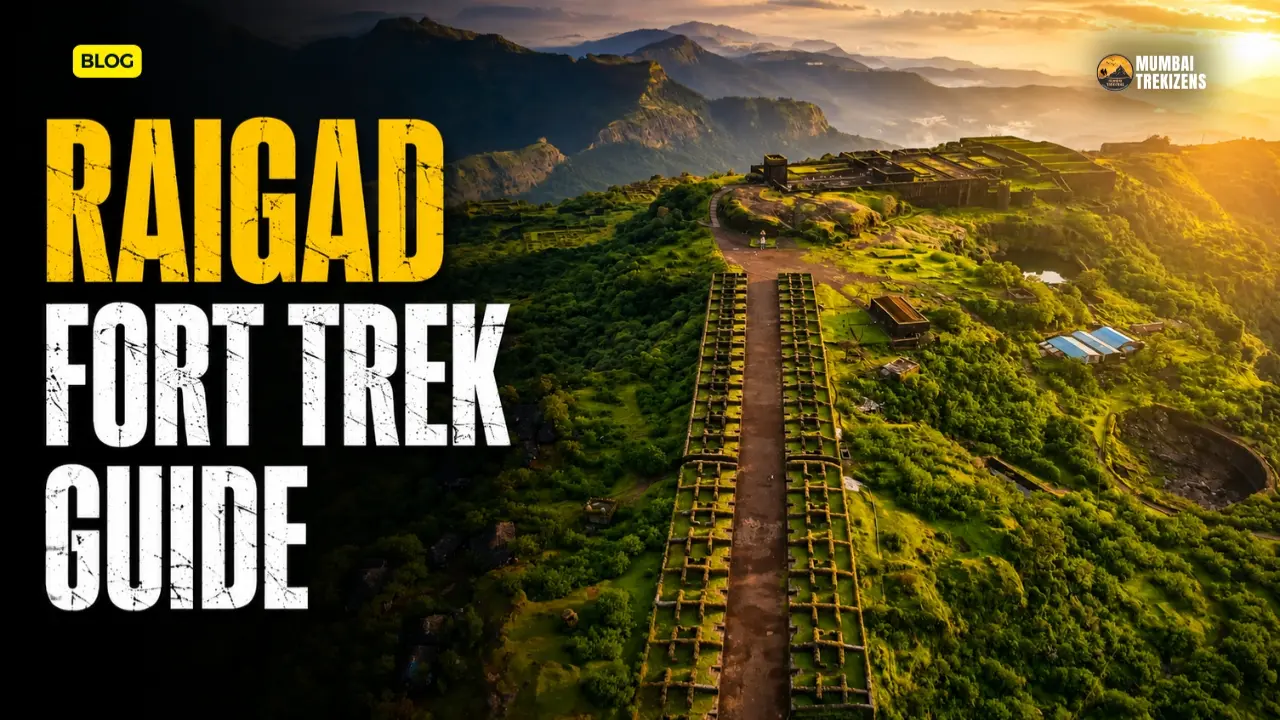
The Raigad Fort trek is less a trek than a pilgrimage with a gradient. You climb roughly 1,737 steps to a plateau that once held a working capital city, and at the top you stand in a throne room where Chhatrapati Shivaji Maharaj was crowned on 6 June 1674. Most Sahyadri forts give you views. This one gives you an address.
It is also the rare Maharashtra fort with a ropeway. That single fact changes who can visit. Grandparents, small children, people with dodgy knees, all of them can reach the top in four minutes. The steps are still there for anyone who wants to earn it.
Table of Contents
- Quick Overview
- Why Raigad Is Different From Every Other Fort Near Mumbai
- How to Reach Raigad Fort
- The Climb: 1,737 Steps From Pachad
- The Ropeway: Fares, Timings, Reality Check
- What to See on Top
- One-Day Itinerary
- Accommodation
- Food
- Nearby Attractions
- Budget Breakdown
- Practical Tips
- Safety Tips
- Common Mistakes
- Best Time to Visit
- FAQ
Quick Overview
| Detail | Information |
|---|---|
| Location | Mahad taluka, Raigad district, Maharashtra |
| Elevation | 820 m above its base; 1,356 m above sea level |
| Base village | Pachad (also the ropeway base station) |
| Steps | Approximately 1,737 |
| Trek duration | Roughly 1.5 to 2.5 hours up, depending on fitness |
| Ropeway duration | 4 minutes each way |
| Difficulty | Easy to moderate on the stepped route; no scrambling |
| Distance from Mumbai | Approximately 170–180 km by road |
| Distance from Pune | Approximately 125–140 km by road |
| Best season | October to February |
| Protected status | Archaeological Survey of India; part of the UNESCO-inscribed Maratha Military Landscapes of India (2025) |
Why Raigad Is Different From Every Other Fort Near Mumbai
Most forts in the Sahyadris were watchposts, toll points or refuges. Raigad was a capital. There is a difference you can feel underfoot.
The plateau held around 1,550 people at its peak, living in an actual settlement with a market street, granaries, a court, palace quarters and reservoirs. Constructed between 1656 and 1674 under the Maratha Empire, with Sardar Hiroji Indulkar as the chief architect, the fort was chosen by Shivaji Maharaj as the seat of Hindavi Swaraj after his coronation. Sambhaji Maharaj was crowned here on 16 January 1681. Rajaram on 11 March 1689. The Mughals held it from 1689 to 1739, the Marathas took it back, and the East India Company took it in 1818.
In July 2025 the Maratha Military Landscapes of India were inscribed on the UNESCO World Heritage List at the 47th session of the World Heritage Committee, making it India's 44th World Heritage property. Raigad is one of the component sites. Expect that status to show up in crowd numbers over the next few years.
An English factor named Henry Oxinden was on the fort from 13 May to 13 June 1674 and left a written description of it. That is a genuine contemporary account, not folklore, and it is worth reading before you go.
How to Reach Raigad Fort
From Mumbai
Drive south on the Mumbai–Goa highway through Panvel, Pen, Nagothane and Kolad to Mahad, then turn inland towards Pachad. Raigad Fort sits roughly 25 km from Mahad town. Total driving time is usually four to five hours, and the highway stretch between Panvel and Mahad is the part that decides your day. Leave Mumbai by 4:30 am on a weekend and you will beat the worst of it.
By public transport: MSRTC buses run from Mumbai Central and Borivali towards Mahad. From Mahad ST stand, catch a local bus or share vehicle to Pachad. There are direct MSRTC services to Raigad Pachad on some days, but they are not dense, so treat Mahad as your reliable transfer point.
By rail, the Konkan Railway stops at Veer and Mangaon, both workable. From Mangaon you will still need road transport to Mahad and onward.
From Pune
The shorter option runs via Bhor and Varandha Ghat to Mahad. The other runs via Tamhini Ghat, Kolad and Mangaon. Varandha is the more scenic of the two and also the one that gets shut or restricted after heavy landslide activity in the monsoon. Check before committing to it.
Pune to Pachad usually takes three to four hours on a clear morning.
From Panvel and Navi Mumbai
Straight down NH-66. You will save close to an hour compared to anyone starting from the western suburbs.
The last mile
Pachad is where the road ends and everything begins. The ropeway base station is here. The stepped route also starts from this side, passing the Chit Darwaja on the way up. Parking is available near the base station.
The Climb: 1,737 Steps From Pachad
Approximately 1,737 steps. That number is repeatedly cited and is the figure you will see quoted at the fort itself.
The steps are wide, broken in places, and relentless in a boring rather than a frightening way. There is no exposure. Nobody needs a rope. What gets people is the monotony and the sun, because the middle third of the staircase has patchy shade and the stone radiates heat by 11 am.
You pass through the Maha Darwaja, the great gate that was historically closed at sunset. Two enormous bastions flank it, roughly 20 to 21 m high. From the Maha Darwaja, the top of the fort is still about 180 m above you. That is the psychological low point of the climb. Push through it.
Reasonable pace: 90 minutes if you trek regularly, two and a half hours if you do not. Add half an hour if you are with children.
Descending on foot is harder on the knees than the ascent is on the lungs. A very common and very sensible plan is to climb up and take the ropeway down. Buy the one-way ticket at the top for that.
Poles help. Proper shoes help more. If you are unsure what to bring, our trekking footwear guide for Sahyadri terrain covers what actually survives basalt steps.
The Ropeway: Fares, Timings, Reality Check
Status: running. As of the current season, the Raigad Ropeway administration states the service is operating.
The ropeway is owned by Shri Shivaji Raigad Smarak Mandal (SSRSM), Pune, an organisation founded by Bal Gangadhar Tilak in 1886, and is operated and maintained by Millennium Ropeways & Infra Private Limited. Construction ran from November 1994 to March 1996.
Technical facts from the operator: - Vertical height: 420 m - Rope length: 760 m - Cabins: 3 - Travel time: 4 minutes - Journey timings: 8:00 am to 5:00 pm
Fares, effective 1 April 2026, as published by the operator:
| Ticket | Fare |
|---|---|
| Two-way, all above age 9 | Rs 325 |
| Two-way, children above 3 and below 9 | Rs 225 |
| Two-way, senior citizens (60 completed, photo ID needed) | Rs 225 |
| Two-way, adult group above 25 persons | Rs 300 each |
| Children up to 3 years | Free |
| One-way, common for all | Rs 225 |
| Physically disabled | Free |
The group discount does not apply to senior citizens. Take a photo ID if you are claiming the senior rate, because they do ask.
at booking.raigadropeway.com and download the e-ticket before you leave home. Mobile data at Pachad is unreliable and you do not want to be refreshing a payment page at the counter.
The operator's contact number is +91-74477 25000. Call it during the monsoon before setting out. Ropeways stop for wind and heavy rain, and Raigad in July can produce both before breakfast.
Third-party travel sites quote different Raigad ropeway fares, some of them badly out of date. Use the operator's own ticket page.
What to See on Top
Maha Darwaja. The only main pathway into the fort passes through it. Two bastions, roughly 20 to 21 m high, and a gate that was locked at sunset.
Holicha Maal. The broad open ground you cross once you are up. Flat, grassy, fully exposed to sun and wind. It is the easiest place on the fort to get sunburnt without noticing.
The Raj Sabha and the throne. A replica of the original throne faces the Nagarkhana Darwaja on the east side. The enclosure was acoustically designed so that a voice from the doorway carried to the throne. Stand at the doorway and test it. It works.
Jagadishwar Temple. Hiroji Indulkar's name is engraved on the first step. That detail is the whole story of the man in one line: the chief architect asked to be placed where every visitor's foot would fall.
Shivaji Maharaj's Samadhi. Beside the Jagadishwar temple, along with the samadhi of his dog, Waghya. The Waghya statue was removed in July 2012 during a protest and later reinstated by SSRSM, the ASI, sculptor Rambhau Parkhi and the district administration.
Hirakani Buruj. A bastion built on a sheer cliff, named after a milkmaid who, according to the legend recorded in accounts of the fort, climbed down that cliff in the dark to get back to her infant son after the gates were locked at sunset. Shivaji Maharaj recognised the cliff as a weakness in the defences and had the bastion built. Whatever you make of the story, the drop below it is real and the bastion is the best sunset spot on the fort.
Takmak Tok. The execution point, a cliff from which sentenced prisoners were thrown. It is now fenced off. Respect the fence. It exists because people have died there.
Also on the plateau: Ganga Sagar Lake, Hatti Talav, Khubladha Buruj, Nane Darwaja, the Palkhi Darwaja on the north side with three deep dark chambers to its right that historians believe were granaries, and the Mena Darwaja on the south, understood to have been the private entrance to the queen's quarters. Three watchtowers stood in front of the palace grounds; two survive, the third was destroyed in a bombardment.
The Samadhi of Rajmata Jijabai is not on the fort. It is at Pachad, at the base. Almost everyone drives past it. Do not.
One-Day Itinerary
4:30 am Depart Mumbai. Depart Pune at 5:30 am.
8:30–9:30 am Reach Pachad. Chai, breakfast, ticket.
9:30 am–11:15 am Climb the steps. Or take the 8:00 am onward ropeway if you are skipping the climb.
11:15 am–2:30 pm Explore. Raj Sabha, Holicha Maal, market street ruins, Jagadishwar temple, samadhi, Hirakani Buruj, Takmak Tok. Three hours is the honest minimum for the fort. Four is better.
2:30 pm Lunch on top or descend and eat at Pachad.
3:30 pm Ropeway down, or walk down by 4:00 pm at the latest.
4:30 pm Jijabai Samadhi at Pachad.
5:00 pm Start back.
Do not cut the return tight. The Mahad–Panvel stretch after dark on a Sunday is a slow crawl.
Accommodation
Raigad is one of the easier forts to overnight at, which is unusual for the Sahyadris.
At Pachad. The Raigad Ropeway project runs accommodation and a restaurant at the base station complex, with online room booking through their website. This is the most straightforward option and it books out on long weekends.
On the fort. MTDC-run and government rest house accommodation has historically existed on the plateau. Availability is inconsistent, so confirm by phone rather than assuming.
Mahad town. Roughly 25 km away, with standard budget hotels. Useful if you want a base for both Raigad and the surrounding Konkan.
Homestays in and around Pachad have grown steadily. They are basic and priced accordingly.
Staying the night is the single best upgrade to a Raigad trip. Sunset from Hirakani Buruj and sunrise over the plateau are worth more than any amount of extra sightseeing.
Food
There are stalls and small eateries at Pachad and near the top station. Standard Maharashtrian fort food: pithla bhakri, poha, vada pav, misal, lemon soda, tea.
The ropeway complex has a restaurant at the base.
Carry your own water for the climb. Two litres per person minimum in winter, three in the shoulder months. Refill points on the stepped route are not something to count on.
Nearby Attractions
Pachad. Jijabai's samadhi, and the ruins of the Pachad wada at the fort's foot.
Mahad. The Chavdar Tale, site of Dr Babasaheb Ambedkar's 1927 satyagraha, is a nationally significant site and sits right in town.
Gandharpale Caves. Buddhist rock-cut caves on the Mahad–Mumbai road, easy to slot in on the drive back.
Sudhagad. A fine, quieter fort further north in the same district, and a good second day if you are making a weekend of it. See our Sudhagad Fort trek guide.
If Raigad leaves you wanting the earlier Maratha capitals, Rajgad and Torna are the logical follow-ups and both are harder walks.
Budget Breakdown
Per person, two people sharing, one-day trip from Mumbai by car.
| Item | Cost |
|---|---|
| Fuel and tolls (shared, round trip) | Rs 900–1,300 |
| Ropeway two-way, adult | Rs 325 |
| Breakfast | Rs 80–120 |
| Lunch | Rs 150–250 |
| Water, snacks, tea | Rs 100 |
| Parking and miscellaneous | Rs 50–100 |
| Total (with ropeway) | Rs 1,600–2,200 |
By public transport, budget roughly Rs 700–1,000 per person including MSRTC fares and the ropeway, but expect the day to run long.
If you climb both ways instead of using the ropeway, subtract Rs 325 and add two hours.
Raigad does not have a published, consistently reported ASI entry ticket figure across reliable sources. Numbers quoted on commercial travel sites conflict with each other and none of them cite an ASI notification, so we are not quoting one. Carry a couple of hundred rupees in cash for whatever is collected at the gate.
Practical Tips
Start early. The single biggest determinant of whether Raigad is a great day or a grim one is what time you leave the city.
Cash. Small denominations. The ropeway takes online payment but stalls, parking attendants and share vehicles generally do not.
Sun protection over rain protection in winter. The plateau has almost no tree cover. A cap and sunscreen matter more here than on a forest trek.
Three hours on top, minimum. People arrive, take photos at the throne, and leave in 45 minutes. They have effectively driven five hours to see a car park.
Read something first. Raigad rewards knowing what you are looking at more than almost any fort in Maharashtra. Ruins without context are just stone.
Mobile network is patchy at Pachad and inconsistent on the plateau. Screenshot your tickets.
Toilets exist at the base station complex and near the top station. Between them, on the staircase, there is nothing.
Safety Tips
The stepped route is not technically dangerous. The risks here are heat, dehydration, and knees.
Heat exhaustion is the real hazard from March onwards. The steps face open sky. If you feel a headache and stop sweating, get into shade immediately and drink.
Takmak Tok has a fence. People climb it for photographs. This is stupid and it has killed people. The drop is sheer.
Hirakani Buruj has similar exposure. Stay behind the parapet.
Monsoon. The steps become slick basalt with algae. Visibility on the plateau can drop to a few metres. The ropeway may be suspended without notice. Our monsoon trekking safety guide for the Sahyadri is worth ten minutes before a July trip.
Descending in the dark on the staircase is avoidable and should be avoided. Be off the steps by 5:30 pm in winter.
Emergency: dial 112. Mahad has the nearest sizeable hospital.
Common Mistakes
Treating it as a photo stop. Raigad needs half a day on the plateau. Budget for it or do not come.
Taking the ropeway both ways and then rushing. The ropeway saves you three hours. Spend the saved time on the fort, not in the car.
Coming in mid-May. The plateau at 40 degrees with no shade is genuinely unpleasant and mildly dangerous.
Assuming the ropeway will run in the monsoon. It stops for wind and heavy rain. Call ahead.
Skipping the Jijabai samadhi at Pachad because it is at the base and everyone is in a hurry to get home.
Believing fare figures from aggregator websites. They are frequently stale. Check the operator's ticket page.
Best Time to Visit
October to February. This is the answer. Clear skies, cool mornings, long visibility from Hirakani Buruj, and the plateau is comfortable to walk for hours. December and January are best.
March to May. Skip it unless you can be up by 8 am and down by noon. The heat on an unshaded plateau at 1,356 m is no joke.
June to September. Beautiful and difficult in equal measure. Green everywhere, waterfalls on the ghat drives, and mist that will erase the view you came for. Steps get slippery. The ropeway may be suspended. Go only if the weather is genuinely on your side, and read our notes on checking the weather before a Sahyadri trek first.
Avoid 6 June entirely unless you specifically want the crowds. The Shiv Rajyabhishek Din anniversary draws enormous numbers to Raigad. It is a remarkable atmosphere and a terrible day for a quiet visit. Choose deliberately.
FAQ
How many steps are there to climb Raigad Fort? Approximately 1,737 steps from the base at Pachad to the fort.
How high is Raigad Fort? It stands 820 m above its base and 1,356 m above sea level.
Is the Raigad ropeway working? Yes. The Raigad Ropeway administration states the service is operating. Journey timings are 8:00 am to 5:00 pm, and the ride takes four minutes. Call +91-74477 25000 before travelling in the monsoon, as the service stops for heavy rain and strong wind.
What is the Raigad ropeway ticket price? Effective 1 April 2026, a two-way ticket is Rs 325 for anyone above age 9, Rs 225 for children between 3 and 9, and Rs 225 for senior citizens aged 60 and above with photo ID. Children up to 3 travel free. A one-way ticket is Rs 225 for all. Groups of more than 25 adults pay Rs 300 each.
How long does the Raigad Fort trek take? Around 1.5 hours up for a regular trekker and up to 2.5 hours for a first-timer. Add three to four hours for exploring the fort itself.
Is Raigad Fort trek suitable for beginners? Yes. It is a stepped route with no scrambling or exposure. Fitness matters, technique does not.
Which is the base village for Raigad Fort? Pachad, in Mahad taluka, Raigad district. The ropeway base station is here, as is the samadhi of Rajmata Jijabai.
When was Shivaji Maharaj's coronation at Raigad? 6 June 1674. He then made Raigad the capital of his Hindavi Swaraj.
Is Raigad Fort a UNESCO World Heritage Site? Raigad is a component of the Maratha Military Landscapes of India, inscribed on the UNESCO World Heritage List in 2025 at the Committee's 47th session. It is India's 44th World Heritage property.
Raigad is the one fort in Maharashtra that does not need you to imagine anything. The throne room is there. The market street is there. The gate that shut at sunset, the cliff a milkmaid climbed down, the temple step with the architect's name on it, the samadhi. It is all present, in stone, at 1,356 m.
The ropeway means you have no excuse. Bring your parents. Bring your kids. Then, some other year, come back and climb the 1,737 steps, because arriving at the Maha Darwaja on foot is a different experience from arriving in a cabin, and you should have both.
Give it a full day. Read a page of history before you go. And stay for one sunset from Hirakani Buruj.
Ready for Your Next Adventure?
Don't just read about it — come experience it. Explore our upcoming treks, camps and tours, all run with certified leaders and small groups.
🏷 Raigad Fort ropeway, Raigad Fort steps, Raigad Fort from Mumbai, Pachad base village, Raigad Fort timings, how many steps to climb Raigad Fort, Raigad ropeway ticket price 2026, Raigad Fort trek difficulty for beginners, best time to visit Raigad Fort from Pune, Raigad Fort trek one day itinerary
Be the first to comment on this post.