Introduction
There is a fort in Raigad district that Chhatrapati Shivaji Maharaj surveyed as a possible capital. He walked its plateau, looked at its water, considered it seriously, and then chose Raigad instead for reasons of location.
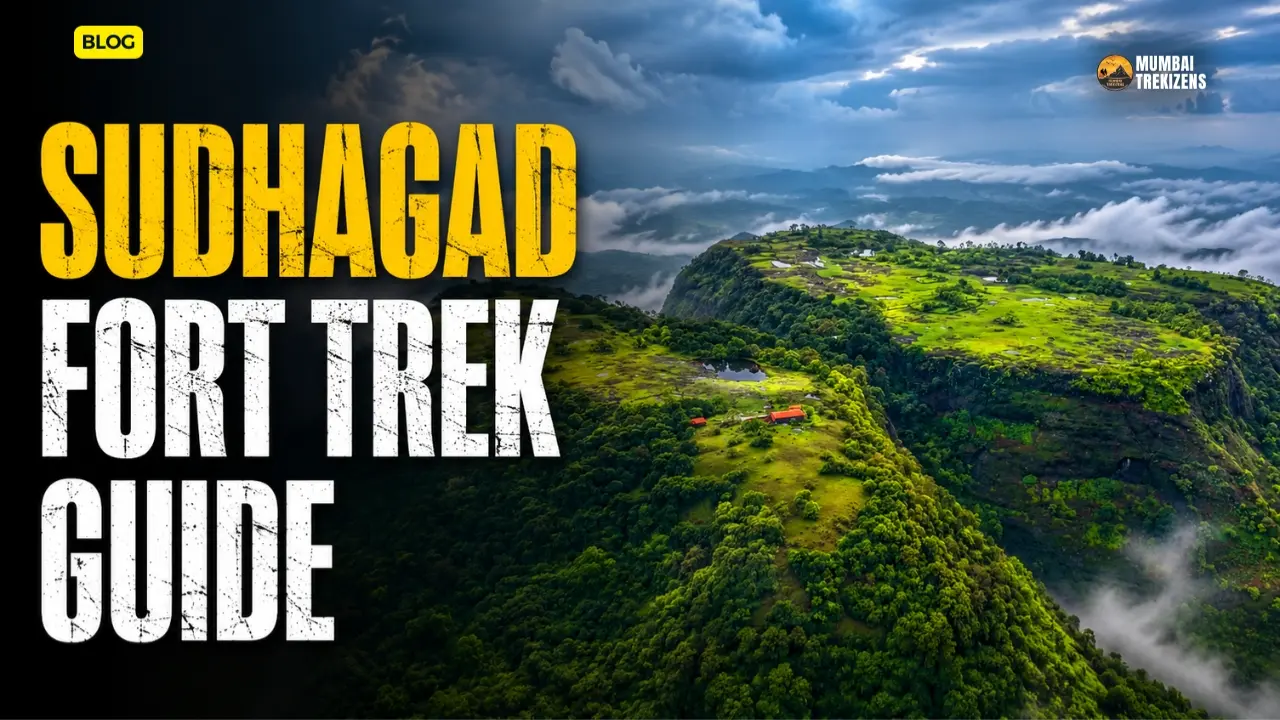
That fort is Sudhagad, and the Sudhagad fort trek is the best-value overnight in this part of the Sahyadri. It has a functioning 1705 CE mansion you can sleep inside. It has a Maha Darwaja that people describe as a smaller version of Raigad's grand entrance, with carvings of Sharabh and musket loopholes intact. It has granaries measuring 60 by 15 feet, a temple with roughly 35 hero stones in the courtyard, two lakes, a Takmak-style cliff point, and a central water tank that holds drinkable water even through summer.
It is also, remarkably for something this good, not crowded.
Sudhagad sits about 11 km east of Pali in Raigad district, roughly 53 km west of Pune and 26 km south of Lonavala, with a summit around 620 metres above sea level. It was called Bhorapgad before the Marathas renamed it, after Bhoraidevi, the goddess still worshipped on top. The whole area around the fort is now a declared wildlife sanctuary.
This guide covers all three routes up, the overnight arrangements as they currently stand, the bus timings from Pali, and how to pair the trek with the Ballaleshwar temple at the base.
Table of Contents
- Quick Overview
- Where Sudhagad Is
- History: Bhorapgad, Sudhagad, and the Bhor Connection
- The Three Routes Up
- What You See on Top
- The Maha Darwaja Descent
- Difficulty Level
- How to Reach Sudhagad
- Suggested Itineraries
- Overnight Stay: Pant Sachiv Wada and Bhoraidevi Temple
- Food and Water
- Combining Sudhagad With Ballaleshwar Pali
- Nearby Attractions
- Budget Breakdown
- Practical Tips
- Safety Tips
- Common Mistakes
- Best Time to Visit
- Frequently Asked Questions
- Conclusion and Call-to-Action
Quick Overview
| Detail | Information |
|---|---|
| Location | Sudhagad-Pali taluka, Raigad district, Lonavala hill range |
| Former name | Bhorapgad, after the goddess Bhoraidevi |
| Height | Approximately 620 m (2,030 ft); MTDC's listing gives 590 m and Durgbharari 1,900 ft |
| Distance from Pali | Approximately 11 km east |
| Distance from Pune | Approximately 53 km west of Pune |
| Distance from Lonavala | Approximately 26 km south |
| Distance from Mumbai | Approximately 130-140 km by road via Khopoli or Pen |
| Base villages | Pachhapur and Thakurwadi (main route); Dhondse and Nadsur (stepped route); Telbaila side (Savaashni Ghat) |
| Trek time | About 1.5 to 2 hours from Pachhapur-Thakurwadi; 2.5 to 3 hours by the Dhondse or Nadsur steps |
| Difficulty | Easy to moderate. MTDC grades it "easy", Durgbharari "medium" |
| Protected status | Sudhagad Wildlife Sanctuary |
| Overnight | Pant Sachiv wada (approximately 50 people) and Bhoraidevi temple (approximately 25) |
| Water on top | Multiple cisterns, lakes and tanks; drinkable water available year-round |
| Best season | October to February; monsoon is excellent for scenery but check district orders |
Where Sudhagad Is
Sudhagad guards the Savaashni Ghat, an old pass on the Pune-Raigad border connecting the Deccan plateau to the Konkan coast. That is the whole reason it exists. The Sahyadri is full of forts that sit on passes, and Sudhagad is one of the more strategically placed ones.
Administratively it is in Sudhagad-Pali taluka, Raigad district. The Wikipedia entry and the Raigad district government's own fort listing both put it about 11 km east of Pali, roughly 53 km west of Pune and 26 km south of Lonavala. Durgbharari records it as barely 10 km from Pali village.
The fort's surrounding area has been declared the Sudhagad Wildlife Sanctuary, so you are walking through protected forest. Tamhini Wildlife Sanctuary lies adjacent along the Mulshi Dam side.
From the summit you can pick out Sarasgad immediately below at Pali, plus Korigad, Ghangad, Telbaila and Taila-Baila, and on a genuinely clear winter day, Karnala away to the north.
Two heights are in circulation. Wikipedia, citing Harish Kapadia's Trek the Sahyadris, gives 620 metres (2,030 ft). MTDC's fort listing says 590 metres. Durgbharari says 1,900 feet, which is about 579 m. These are different measurements of a large plateau summit rather than a contradiction. Treat it as roughly 590 to 620 m.
History: Bhorapgad, Sudhagad, and the Bhor Connection
The fort's origin is usually placed in deep antiquity. Wikipedia notes the claim that it dates to the 2nd century BCE, contemporary with the nearby Thanale and Khadsamble caves, and flags the sourcing for that claim as unreliable. Take it as tradition rather than fact. What is better established is that a fort existed here by the early 1400s.
It was called Bhorapgad, after its presiding deity Bhoraidevi. Sage Bhrugu is said in local tradition to have meditated here and installed the goddess's idol; Bhoraidevi is also known as Bhrugu Amba.
- 1436: captured by the Bahmani Sultan.
- 1648 or 1657: the Marathas took the fort and renamed it Sudhagad, "the sweet one". The sources differ on the year. Wikipedia gives 1657. Durgbharari gives 1648 CE, and adds a detail worth having: chronicles describe Maloji Bhosale's troops scaling the fort walls to claim it for Swarajya.
- Considered as capital: Sudhagad was a large fort and was seriously considered by Chhatrapati Shivaji Maharaj as the capital of his kingdom. He surveyed it, then chose Raigad for its more central position. This is why Sudhagad is repeatedly called a replica of Raigad — the Maha Darwaja, the Takmak-style cliff point, the granary blocks and the plateau layout all echo it at a smaller scale.
- Pachhapur meeting: at the base village of Pachhapur, Sambhaji Maharaj met Prince Akbar, Aurangzeb's rebellious son.
- The Pantsachivas: under the Peshwas, the Pantsachivas of Bhor became custodians of the fort. Chhatrapati Shahu Maharaj granted them the hereditary position of State Secretaries, and under the British they were recognised as rulers of the Bhor princely state. They treated Bhoraidevi as their kuldaivat and renovated her temple.
- After 1950: with the annexation of the princely states, the fort became patronless. It escaped British destruction, but neglect did the work instead, which is why so much survives and so much is ruined at the same time.
The Pant Sachiv wada on top is dated by Durgbharari to 1705 CE, a quadrangular mansion with two entrances, a wide veranda, two rooms and an upper storey, recently restored by the Bhorai Temple Trust.
The Three Routes Up
Sudhagad has three approaches, and they are genuinely different experiences.
1. Pachhapur / Thakurwadi — the main route
This is the one to take. Pachhapur sits about 8 km along the Pali-Bhira road, and Thakurwadi is just beyond it. From here the climb is comparatively easy and takes roughly 1.5 to 2 hours.
MTDC's listing gives one and a half hours from Pachhapur-Thakurwadi. Durgbharari says about two hours. Wikipedia says 1 to 2 hours to reach the top by the Thakurwadi route and notes it as the most popular and regularly used.
Important: there are no water cisterns on the way up. Water is abundant on top and absent on the climb.
You enter through the Pachhapur Gate, flanked by two massive bastions with stairways up to observation points, built specifically to watch the Pachhapur and Thakurwadi approaches. Within about ten minutes of climbing past the gate a large water reservoir appears. Keep it on your left and walk on, and you pass ruined houses and old settlement remains.
From Thakurwadi village you can see the fort's massive walls rising right behind the temple. It is a good moment.
2. Dhondse or Nadsur — the stone steps
From Pali you can reach Nadsur or Dhondse village and climb well-built stone steps. Durgbharari puts this at two and a half to three hours. MTDC notes the Dhondse route takes longer than the Pachhapur one, with the first ST bus from Pali to Dhondse leaving at 8:15 am.
Take this route if you want the steps and the extra height gain, or if you are combining Sudhagad with the caves on that side. Do not take it if you are on a tight single-day schedule.
3. Telbaila / Savaashni Ghat — the top-down approach
The third approach comes via Telbaila near Savaashni Ghat, arriving directly at the Gurmukhi Maha Darwaja, which leads straight to the Bhoraidevi temple. This is the route that comes in from the Pune side of the ghat rather than the Konkan side.
It is the most interesting arrival, because you walk in through the fort's grandest gate rather than a side entrance. It is also the least served by public transport.
Recommendation: go up by Pachhapur-Thakurwadi and come down through the Maha Darwaja for the architecture, or do it as a loop if you have your own vehicle and a driver willing to reposition.
What You See on Top
Sudhagad's summit is a large plateau, and this is the reason it deserves an overnight instead of a rushed day. Durgbharari's assessment is that exploring the entire fort takes a full day. That is accurate.
Working through it:
- Pant Sachiv wada. The 1705 CE quadrangular mansion, restored by the Bhorai Temple Trust. Two entrances, wide veranda, two rooms, upper storey. Accommodation for around 50. A newly built dharamshala stands opposite. Behind the wada: a platform-style Shiva temple, overgrown ruins, and a square well, now dry.
- Bhoraidevi Temple. The spiritual centre of the fort and the reason for its old name. A deepmala (lamp pillar) with an elephant carving at its base, a huge bell, and around 35 hero stones (virgal) in the courtyard. Accommodation for about 25 people here.
- The hidden escape gate. Near the Bhoraidevi temple, a small gate built inside a bastion served as an escape route. Access to this gate was restored as part of a restoration initiative by the Trekshitiz group.
- Amberkhana (granaries). A group of massive, uniformly built storerooms, each roughly 60 by 15 feet, on a raised plinth. Take the right path from the temple.
- Takmak Point. A cliff edge deliberately reminiscent of Raigad's Takmak Tok, with long views down the valleys. Respect the edge.
- The western plateau. Large water tanks and ruins of ancient structures. Sarasgad is visible from here, and Karnala on clear days.
- Two lakes and the central tank. Durgbharari records that the central tank retains drinkable water even in summer. That is unusual and it is one of the reasons this fort could be garrisoned year-round.
- Ruins across the plateau. Tombs, a shrine (Vrindavan), two ruined Shiva temples, a big granary, and scattered remains. Three main gates in total.
MTDC additionally lists the Bhoreshwar temple, the Pachhapur Darwaja and the Dindi Darwaja as places to seek out.
The Maha Darwaja Descent
Do not skip this even if you came up another way. Walk down through it and back up.
Descending through the Maha Darwaja is, in Durgbharari's phrase, like walking through a smaller version of Raigad's grand entrance. Details worth looking for:
- Two flanking bastions.
- Carvings of Sharabh, the mythical beast, plus intricate decorative work.
- Guard chambers built into the gate structure.
- Water channels.
- Musket loopholes, positioned so defenders on the bastions above could target anyone advancing up the gorge below.
Keep going down past the gate and you reach two more ruined gateways, the Tanaji and Hanuman water cisterns — one with a soldier carved on its surface — a dilapidated Shiva temple, and a Maruti idol known as Kasarpet Maruti.
This lower section is where Sudhagad stops being a nice green walk and starts being a serious piece of military architecture. Budget forty minutes for it.
Difficulty Level
Easy to moderate, and the sources bear this out from both directions: MTDC grades Sudhagad "easy", Durgbharari grades it "medium".
Both are defensible. The Pachhapur-Thakurwadi trail is short, well-used, shaded in parts, with no exposure and no rock climbing. Ninety minutes of steady walking. A reasonably fit first-timer will be fine.
What makes it "medium" rather than trivial:
- No water on the ascent. You carry everything you need for the climb.
- The Dhondse and Nadsur step routes are considerably longer at two and a half to three hours.
- The plateau is large. Walking the full circuit on top after a 90-minute climb adds real distance to the day.
- Monsoon changes the maths entirely. Wet stone steps and leech-heavy forest.
Sudhagad is a genuinely good first overnight fort for a beginner. Short climb, water and shelter at the top, plenty to explore, no technical sections. It is a much better introduction than anything on the Panvel pinnacles. If you are new to this, run through the Sahyadri trekking safety checklist for beginners before you pack.
How to Reach Sudhagad
Pali is the hub. Everything routes through it.
To Pali
- From Mumbai: road via Panvel and Pen or via Khopoli, roughly 130 to 140 km. By train, Konkan Railway to Nagothane, then ST bus or six-seater rickshaw to Pali — MTDC records the Nagothane-Pali distance as about 10 km with frequent ST service.
- From Pune: roughly 120 km by road via Lonavala and Khopoli, or via the Tamhini and Mulshi side if you want the scenic run. Sudhagad itself is about 53 km west of Pune in straight-line terms but the driving distance is much longer because of the ghat.
- From Karjat or Khopoli: both are on Central Railway. ST buses run from Karjat and Khopoli to Pali.
- From Lonavala: roughly 26 km south as the crow flies, longer by road.
From Pali to the base villages
MTDC lists two ST options from Pali, and these are useful because they set your morning:
- Pali to Pachhapur-Thakurwadi: first bus leaves Pali at 7:15 am. About 1.5 hours of trekking from there to the top.
- Pali to Dhondse: first bus leaves Pali at 8:15 am. This route takes longer to the summit.
Caveat: MTDC's page carrying these timings dates from 2019. ST schedules on rural Raigad routes change. Confirm at the Pali stand the evening before, or on the MSRTC enquiry line. If you miss the bus, six-seater rickshaws from Pali are the fallback and worth sharing.
Pachhapur is about 8 km along the Pali-Bhira road.
Own vehicle
Drive to Pachhapur or Thakurwadi and park in the village. Ask before you park; these are working lanes. The road in is narrow and rough in places, and after heavy rain it is worse.
Mobile network: thin in the base villages, mostly absent on the plateau. Download offline maps. Tell someone your plan.
Suggested Itineraries
Option A — The overnight (this is the right way to do Sudhagad)
Day 1 - Morning: travel to Pali. Visit the Ballaleshwar temple before it gets busy. - 1:00 pm: lunch in Pali. Stock up on water and food for the fort. - 3:00 pm: reach Pachhapur or Thakurwadi. - 3:15 pm: start climbing. - 5:00 pm: on the plateau. Settle into the Pant Sachiv wada or the Bhoraidevi temple hall. - Evening: Takmak Point for sunset. Dinner. The plateau at night with no city glow is the actual reason to stay up here.
Day 2 - 6:15 am: sunrise from the western plateau. - 7:00 am to 10:30 am: the full circuit. Bhoraidevi temple and its hero stones, the granaries, the hidden escape gate, the lakes, then down through the Maha Darwaja and back up. - 11:00 am: descend. - 12:30 pm: base village. Bus or rickshaw to Pali. - Afternoon: Sarasgad if you have energy, or head home.
Option B — Single day from Pune or Mumbai
- 5:00 am: leave.
- 8:30 am: Pachhapur or Thakurwadi.
- 10:00 am: on top.
- 10:00 am to 2:00 pm: Bhoraidevi temple, granaries, Takmak Point, Maha Darwaja.
- 3:00 pm: base village.
- 7:00 pm: home.
Workable November to February. Tight and hot in March. Do not attempt in May.
If you are Pune-based and want other options in this radius, our one-day treks near Pune roundup covers shorter alternatives.
Overnight Stay: Pant Sachiv Wada and Bhoraidevi Temple
This is Sudhagad's best feature and the reason it beats most forts in this district as a weekend plan.
Pant Sachiv wada
The 1705 CE mansion on the plateau. Around 50 people can stay in it. Wikipedia, MTDC and Durgbharari all record it as usable for a night halt, and Durgbharari notes it was recently restored by the Bhorai Temple Trust, with a newly built dharamshala opposite it.
Wikipedia's note is explicit: the night halt on the fort in any season can be made at the Pant Sachiv wada or the Bhoraidevi temple.
Bhoraidevi temple
The temple hall accommodates around 25 people and is described as a good place for a night on the fort.
Current status — read this
The overnight arrangement at Sudhagad is a temple trust and local caretaker arrangement, not a booked hotel. There is no reservation website, no confirmation email, no guarantee. What that means in practice:
- It is first come, first served, and on long weekends and around festivals both the wada and the temple hall fill up with large groups.
- Carry your own sleeping mat and sleeping bag or blanket. You are getting a roof and a floor.
- A caretaker on the fort can arrange basic food for a small number of people, but only if asked. MTDC's listing names Mr. More, who stays on the fort and can arrange food for four to five people. That was recorded some years ago and the specific person may have changed. Do not build your dinner plan around it.
- Verify before you go. Restoration work, temple trust decisions and sanctuary rules can change what is open. Ask in Pali or at Thakurwadi on the way up. If sleeping indoors matters to your plan, carry a tent as backup.
We are marking this as partially verified: multiple sources including MTDC and Wikipedia confirm the wada and temple as sanctioned night-halt options and confirm the wada's restoration, but no source gives a current-season occupancy or booking procedure, because there is not one.
Food and Water
Water is Sudhagad's superpower. MTDC's listing is unambiguous: there are many cisterns, lakes and tanks on the fort, and drinking water is available throughout the year. Durgbharari adds that the central tank retains drinkable water even in summer. Two water ponds are recorded on the fort.
That said: there is no water on the climb up. Wikipedia states plainly that there are no water cisterns on the way from Thakurwadi. Carry 2 litres for the ascent, then refill on top.
And filter or purify what you take from the tanks. It is open standing water in a wildlife sanctuary. A basic filter or purification tablets weigh nothing.
Food: plan to be self-sufficient. MTDC's guidance is that it is better to make your own food arrangements, with the fort caretaker as a fallback for four to five people. Buy everything in Pali, which has proper shops. The base villages have very little.
Cooking on the fort: use a small stove if you must, keep it well away from structures and dry grass, and pack out every scrap. This is a wildlife sanctuary. Open fires are a bad idea and in many protected areas an illegal one.
Combining Sudhagad With Ballaleshwar Pali
This is the pairing that makes a Sudhagad weekend genuinely worth the travel time, and it is why Pali is the hub rather than just a bus junction.
Shri Ballaleshwar at Pali is one of the eight Ashtavinayak temples, and the only Ganesha incarnation among them known by his devotee's name rather than his own. The temple stands between Sarasgad fort and the Amba river.
So a Sudhagad weekend gives you an Ashtavinayak darshan, a hill fort that nearly became a capital, and a second fort (Sarasgad) rising directly behind the temple — inside 15 km.
Practical sequencing: temple first, fort after. Ballaleshwar is busiest late morning and on Sankashti and Chaturthi days, so go early. Then eat in Pali, then head to Pachhapur.
If you are building a longer pilgrimage circuit around it, our Ashtavinayak Yatra complete guide covers the full eight-temple sequence, the routing and the darshan timings.
Nearby Attractions
- Sarasgad fort, Pali. Rises directly behind the Ballaleshwar temple. Steeper and shorter than Sudhagad, with cut steps. A good half-day on its own and visible from Sudhagad's western plateau.
- Thanale Caves and Khadsamble caves. Ancient rock-cut caves in the same area, traditionally linked to Sudhagad's early period.
- Telbaila. The extraordinary vertical rock wall near Savaashni Ghat, visible from the fort. A technical climbing objective, not a walk-up.
- Ghangad and Korigad. Both visible from Sudhagad's summit, both on the Lonavala-Mulshi side. If you like this scale of fort, see the Tikona fort trek guide and the Lohagad fort trek guide for the nearest comparable outings.
- Bhira and the Amba valley. The road out from Pachhapur runs into some of the quietest scenery in Raigad.
Budget Breakdown
Per person, two sharing, overnight version, from Mumbai.
| Item | Cost (INR) |
|---|---|
| Mumbai to Pali by train and ST bus (return) | 250 - 450 |
| Pali to Pachhapur ST bus or shared rickshaw (return) | 100 - 250 |
| Overnight in the Pant Sachiv wada or temple hall (donation / caretaker charge) | 100 - 300 |
| Food bought in Pali for the fort | 250 - 400 |
| Lunch in Pali, day one | 120 - 200 |
| Local guide, if hired (shared between group) | 500 - 1,000 per group |
| Buffer | 150 |
| Total per head, DIY overnight | approximately 900 - 1,600 |
By car from Pune, two sharing: fuel and tolls roughly ₹1,200 to ₹1,800 for the return run, plus food and the night halt. Works out similar per head.
Carry cash. UPI is unreliable at the base villages and useless on the plateau. Carry small notes for the temple trust and caretaker; there is no card machine on a 320-year-old wada.
Practical Tips
- Do the overnight. A single day gives you the plateau but not the plateau at dawn, and the whole point of Sudhagad is the space and the quiet.
- Confirm the ST timings the evening before. The MTDC-listed 7:15 am to Pachhapur-Thakurwadi and 8:15 am to Dhondse are the published first departures but the page is several years old.
- Buy food in Pali, not the base village.
- Carry 2 litres for the climb and a filter for the top. Water is plentiful up there but it is standing water.
- Sleeping mat and sleeping bag, minimum. The wada is a roof, not a room service.
- Go up Pachhapur, come down through the Maha Darwaja. Best sequence for the architecture.
- Weekdays and non-festival weekends are dramatically quieter, and the wada is much more likely to be free.
- Grippy shoes. The Dhondse steps and the Maha Darwaja gorge section are polished stone. See our trekking footwear guide for Sahyadri terrain.
- Respect Bhoraidevi temple. It is an active place of worship maintained by a trust and is also your bedroom. Shoes off, no alcohol, keep it clean.
Safety Tips
- This is a declared wildlife sanctuary. Stay on established paths, keep noise down after dark, do not leave food out. Snakes and leopards are part of this forest. Our wildlife safety on Sahyadri treks guide covers night-halt precautions specifically.
- Takmak Point is an unguarded cliff edge. There is no railing. Do not go near it in wind, in the dark, or for a photo.
- No mobile signal on the plateau. Leave your route and expected return with someone at home. Carry a power bank.
- Water needs treating. Cistern and lake water is drinkable by long tradition but it is open water. Filter or boil.
- Do not descend the Maha Darwaja section in the dark. Polished stone, collapsed edges, no handrails.
- Monsoon: the fort is beautiful and the routes get slippery. The Dhondse and Nadsur stone steps in heavy rain are genuinely dangerous. Read our monsoon trekking safety guide for the Sahyadri before a July or August attempt, and check the Raigad district collector's prohibitory orders — the district has restricted access to specific forts and waterfalls during peak rainfall in recent seasons.
- Carry a real first aid kit. You are 90 minutes from a road and hours from a hospital. The first aid kit for Sahyadri treks list is the right baseline for an overnight.
- Headtorch per person, not per group.
Common Mistakes
- Assuming the wada is bookable. It is not. Turn up on a long weekend and you may be sleeping outside.
- Not carrying water for the ascent because you read that Sudhagad has water year-round. It does. On top. Not on the way up.
- Doing it as a rushed single day and seeing the Bhoraidevi temple but not the granaries, Takmak Point or the Maha Darwaja.
- Relying on the fort caretaker for dinner for a group of twelve.
- Taking the Dhondse route on a tight schedule. It is an hour longer each way than Pachhapur.
- Skipping the Maha Darwaja because you came up the other side. It is the single best structure on the fort.
- Treating a functioning temple as a campsite. Alcohol, shoes and loud music inside the Bhoraidevi hall are how trekkers get the fort closed to trekkers.
- Leaving litter on a plateau with no waste collection.
Best Time to Visit
MTDC's answer is "any time except summer," and that is close to right. Ours is more specific.
- October to November: the best window without argument. The plateau is still green, the tanks are full, the air is clear, and temperatures are civil. Post-monsoon October at Sudhagad is as good as this district gets.
- December to February: excellent for the overnight. Cold nights on the plateau, which is a feature not a bug if you have a sleeping bag. Best visibility for Sarasgad, Korigad, Telbaila and the long shot at Karnala. Dry footing on the Maha Darwaja stones.
- March: fine with an early start. The plateau is exposed and it warms up fast.
- April and May: skip it. Konkan pre-monsoon heat, brown plateau, and a climb with no water. The fort's tanks will still have water, which is remarkable, but that does not make the ascent pleasant. If you must go in May, walk up at first light and sit out midday in the wada.
- June to September: Sudhagad in the monsoon is genuinely spectacular — the Pant Sachiv wada in the rain is one of the better sights in Raigad. But the stone steps on the Dhondse and Nadsur routes become dangerous, leeches are everywhere in the forest sections, and the plateau turns into low cloud with no view. Go for the atmosphere, not the panorama, take the Pachhapur route, and check the district collector's current orders before you commit.
For a first visit: second half of November. Green, dry, clear, cool nights, and the long-weekend crowds have gone.
Frequently Asked Questions
1. How high is Sudhagad fort? The summit is approximately 620 metres, about 2,030 feet, above sea level according to Wikipedia citing Harish Kapadia's Trek the Sahyadris. MTDC's fort listing gives 590 metres and Durgbharari gives 1,900 feet. Treat it as roughly 590 to 620 m; the variation reflects different measurement points on a large plateau summit.
2. Can you stay overnight on Sudhagad fort? Yes. A night halt can be made at the Pant Sachiv wada, which accommodates around 50 people, or at the Bhoraidevi temple, which accommodates around 25. The wada, a 1705 CE mansion, was restored by the Bhorai Temple Trust and has a newly built dharamshala opposite it. It is not a bookable property — it is first come, first served, and you should carry your own sleeping mat and bag. Confirm availability locally before relying on it.
3. How long is the Sudhagad fort trek? About 1.5 to 2 hours from Pachhapur-Thakurwadi, the most popular route. The Dhondse or Nadsur stone-step route takes roughly 2.5 to 3 hours. Exploring the entire summit plateau properly takes most of a further day, which is why the overnight is the better plan.
4. What was Sudhagad called earlier? Bhorapgad, after its presiding deity Bhoraidevi. The Marathas renamed it Sudhagad, meaning "the sweet one", after taking it in the mid-1600s.
5. Is Sudhagad fort trek suitable for beginners? Yes, and it is one of the better beginner options in Raigad. MTDC grades it "easy" and Durgbharari "medium". The Pachhapur-Thakurwadi trail has no exposure and no rock climbing, water and shelter are available on top, and there is plenty to explore. Carry your own water for the ascent since there are no cisterns on the way up.
6. How do I reach Sudhagad from Pune? Sudhagad is roughly 53 km west of Pune in straight-line terms, with a longer road distance via Lonavala and Khopoli to Pali, or via the Mulshi and Tamhini side. From Pali, take the ST bus or a six-seater rickshaw toward Pachhapur, about 8 km along the Pali-Bhira road, then Thakurwadi. The published first bus from Pali to Pachhapur-Thakurwadi leaves at 7:15 am, but confirm current timings locally.
7. Is there food and water on Sudhagad fort? Water yes, food no. The fort has multiple cisterns, lakes and tanks and drinking water is available year-round, with the central tank holding drinkable water even in summer. Filter or boil it anyway. For food, buy everything in Pali. A caretaker on the fort can arrange basic meals for four to five people, but do not plan around it for a group.
8. Why is Sudhagad called a replica of Raigad? Because Chhatrapati Shivaji Maharaj surveyed it as a possible capital before choosing Raigad for its more central location, and because the fort's architecture echoes Raigad at a smaller scale: a grand Maha Darwaja with flanking bastions, guard chambers and musket loopholes, a Takmak-style cliff point, large granary blocks and a broad plateau summit.
Sudhagad is the rare Sahyadri fort where the history, the architecture and the practical logistics all line up. Ninety minutes of walking gets you to a plateau with drinkable water, a roof from 1705 that you are permitted to sleep under, granaries sixty feet long, a temple with thirty-five hero stones in its courtyard, and a gateway that gives you a real sense of what Raigad's entrance must have felt like to approach uninvited.
And the fort's own biography is hard to beat. Bhorapgad under a goddess, taken by the Bahmani Sultan in 1436, taken by Maloji Bhosale's men for Swarajya, surveyed as a capital and passed over, handed to the Pantsachivas who ran the Bhor state, then left patronless in 1950.
Go in late November. Take the Pachhapur route up, sleep in the wada, be at Takmak Point for sunrise, and walk down through the Maha Darwaja before you leave. Pair it with Ballaleshwar at the base and you have the best weekend Raigad district offers for the money.
Ready for Your Next Adventure?
Don't just read about it — come experience it. Explore our upcoming treks, camps and tours, all run with certified leaders and small groups.
🏷 - Sudhagad fort overnight stay, - Pant Sachiv wada Sudhagad, - Bhorapgad fort Raigad, - Sudhagad trek from Pali, - Pachhapur Thakurwadi route Sudhagad, - can you stay overnight on Sudhagad fort, - how to reach Sudhagad fort from Pune by bus, - Sudhagad fort trek difficulty for beginners, - Sudhagad and Ballaleshwar Pali one weekend plan, - Sudhagad fort trek best time to visit
Be the first to comment on this post.