Introduction
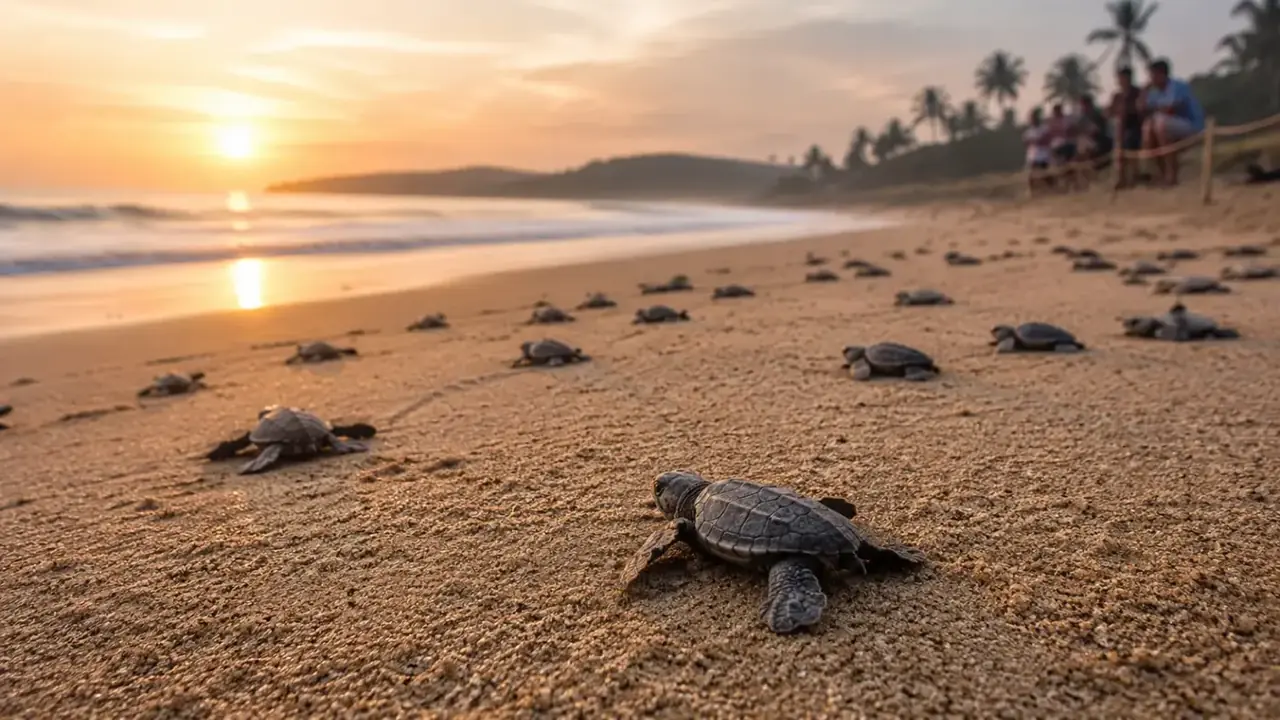
Picture this: early dawn on a quiet Konkan beach, and out of the sand emerge hundreds of tiny hatchlings, instinctively crawling toward the sea the moment they're born. This isn't a scene from a wildlife documentary. It happens every year in Velas, a small village in Maharashtra's Ratnagiri district.
The Velas Turtle Festival is one of Maharashtra's most celebrated eco-tourism events. Between February and April, Olive Ridley sea turtle hatchlings are released into the sea here, and thousands of visitors travel to Velas each year to witness this rare natural moment.
This guide covers the real story behind the festival, genuine facts about the turtles that visit this coast, and the rules every visitor needs to follow to keep this conservation effort working.
Table of Contents
- What the Velas Turtle Festival Actually Is
- How the Festival Started: Sahyadri Nisarga Mitra's Work
- Festival Duration and the Best Time to Visit
- Olive Ridley Turtles: Genuine Facts
- The Turtle Life Cycle: From Egg to Sea
- How to Reach Velas
- Where to Stay and Eat
- Rules You Must Follow at the Festival
- What to Pack
- Nearby Attractions
- Frequently Asked Questions
What the Velas Turtle Festival Actually Is
Velas is a small tribal and fishing village in Mandangad taluka of Ratnagiri district, situated between the Savitri and Bharaja rivers. It sits roughly 200 to 220 kilometers from Mumbai and stays quiet for most of the year, except during turtle season.
Between February and April, protected turtle eggs on the village beach hatch, and volunteers release the hatchlings safely into the sea. Nature lovers, researchers, photographers, and everyday travelers come from across India and abroad to watch this. Maharashtra's monsoon synchronized firefly displays draw a similarly dedicated crowd months later.
How the Festival Started: Sahyadri Nisarga Mitra's Work
The Velas Turtle Festival sits on top of a genuine, decades-long conservation effort. Sahyadri Nisarga Mitra (SNM) was founded on 12 February 1992, and became the first organization in Maharashtra to start marine turtle conservation work.
In 2002, SNM began actual protection work for Olive Ridley turtles in Velas. In its first year, the effort covered just one village and successfully protected 50 nests. Today, that same conservation model has spread across Maharashtra's entire 720-kilometer coastline.
In 2006, SNM launched the Velas Homestay program, under which more than 19 local households host visitors in their own homes. This gives villagers a source of income tied directly to conservation, rather than to poaching or selling turtle eggs. The local Kasav Mitra Mandal, Velas works alongside Sahyadri Nisarga Mitra on this effort.
Festival Duration and the Best Time to Visit
The Velas Turtle Festival doesn't run on fixed dates, since it depends entirely on natural cycles. Here's the general pattern:
- Female turtles arriving and laying eggs: typically from October through January
- Peak hatching and hatchling release season: February through April
- Busiest period with the most releases: March and early April
Hatchling releases generally happen twice a day, around 6:30 AM and 5:30 PM, but this depends entirely on natural conditions and the guidance of conservation volunteers. There's no guarantee turtles will be visible on any specific day or time.
Tip: if you'd rather avoid the crowds, visiting in early February (when females are laying eggs) or late March tends to be quieter. The Sahyadris have their own rare-timing spectacle too, the Karvi flower's once-in-eight-years bloom.
Olive Ridley Turtles: Genuine Facts
The turtles that visit Velas belong to the Olive Ridley species (scientific name: Lepidochelys olivacea). This is one of the smallest sea turtle species in the world and is currently classified as endangered.
A few genuine facts worth knowing:
- Olive Ridley is the dominant turtle species along Maharashtra's 720-kilometer coastline, and around 40% of these turtles prefer Velas beach for nesting
- A female turtle comes ashore at night and lays roughly 80 to 120 eggs
- After laying eggs, the female returns to the sea and doesn't stay to care for the hatchlings
- Eggs take approximately 40 days to hatch
- Other turtle species, including the Green Turtle, Hawksbill, and Leatherback, have occasionally been recorded along Maharashtra's coast, but Olive Ridley remains the main species seen regularly at Velas
In the past, these eggs were often sold in local markets or destroyed by stray dogs and predators. Conservation efforts over the past two decades have led to a noticeable recovery in Olive Ridley numbers along this coast.
The Turtle Life Cycle: From Egg to Sea
Understanding what actually happens during the festival makes the experience more meaningful:
- Egg-laying: A female turtle comes ashore under cover of night and digs a pit in the sand to lay her eggs.
- Protection: Volunteers locate these nests and relocate the eggs to a protected, fenced hatchery area, keeping them safe from stray dogs, jackals, and human interference.
- Incubation: Eggs hatch after roughly 40 days.
- The journey to the sea: Hatchlings emerge and instinctively crawl toward the ocean the moment they're born, this is the moment visitors come to witness.
- Entering the sea: Once hatchlings reach the water, they begin swimming independently.
This entire cycle is natural, and human involvement is kept to a minimum, limited mainly to protecting the eggs from predators and poaching.
How to Reach Velas
From Mumbai: The route runs via Panvel, Mahad, and Mandangad to Velas. The distance is roughly 200 to 220 kilometers and takes about 6 to 7 hours by road.
From Pune: The distance to Velas is around 200 kilometers.
By Train: The nearest railway station is Khed, about 65 kilometers away. From there, you'll need a private vehicle or taxi to continue to Velas.
Via the Bagmandla-Harihareshwar ferry route: Some travelers reach Velas by taking the ferry from Harihareshwar via Bagmandla, a scenic alternative.
Tip: the roads to Velas are hilly and narrow in places, so those driving themselves should budget extra travel time.
Where to Stay and Eat
There are no large hotels or resorts in Velas. Under the Velas Homestay program, local families host visitors in their own homes. These stays are simple by design:
- Accommodation is often shared, sometimes in large hall-style rooms
- Meals are home-cooked, local Konkani-style food: simple, fresh, and flavorful
- Bathroom and washroom facilities are basic; don't expect five-star amenities
- Resort-style accommodation is available only in nearby Harihareshwar or Dapoli
Staying with a local family is an opportunity to experience Konkani culture up close, so it's best approached as a cultural experience rather than judged against hotel standards.
Rules You Must Follow at the Festival
Turtle conservation is the entire point of this festival, so visitors are expected to follow these rules strictly:
Photography - Never use flash photography. Bright light can disorient hatchlings and send them in the wrong direction, putting their survival at risk. - Avoid shining phone or torch light directly at the hatchlings too.
Behavior Around Hatchlings - Never touch or pick up the hatchlings. Their instinctive crawl toward the sea is part of their natural orientation process. - Never attempt to place hatchlings directly into the water yourself.
Noise and Discipline - Maintain silence on the beach; avoid loud talking or commotion. - Don't cross barricades set up by volunteers or forest department staff, since these mark the path hatchlings use to reach the sea.
Cleanliness - Velas beach is a plastic-free zone, so avoid using plastic items and don't litter. - Carry your own waste back with you.
Safety - Velas beach is considered one of the more dangerous beaches along the Konkan coast, so never swim alone. - If you spot an injured or sick turtle, immediately inform a volunteer or forest department official rather than handling it yourself.
Other - Alcohol, smoking, and other intoxicants are not permitted during the event. - Respect local customs and traditions, especially at nearby religious sites.
What to Pack
- Comfortable, simple clothing (light warm layers help for early morning beach visits)
- Comfortable walking shoes or sandals
- A torch (use sparingly and responsibly on the beach)
- A power bank, since electricity and network coverage can be limited in the village
- A camera or phone that can shoot without flash
- Personal medicines
- Mosquito repellent
- A reusable water bottle to avoid single-use plastic
Nearby Attractions
Worth combining with your Velas trip:
- Bankot Fort: A historic fort where the Savitri River meets the Arabian Sea, also known as Himmatgad or Fort Victoria
- Harihareshwar Temple: An ancient Shiva temple surrounded by four sacred hills, Harihar, Harshinachal, Bramhadri, and Pushpadri, known for its unique circumambulation (pradakshina) route
- Harihareshwar Beach: A calm, scenic beach that's a good spot to relax and unwind
Frequently Asked Questions
1. When exactly does the Velas Turtle Festival happen? There are no fixed dates, since it depends on natural cycles. The festival generally runs from February to April, with March and early April being the busiest period for hatchling releases.
2. Which turtles come to Velas? Primarily the Olive Ridley (Lepidochelys olivacea), an endangered sea turtle species. Other species have occasionally been recorded along Maharashtra's coast, but Olive Ridley is the main species seen regularly at Velas.
3. Is seeing hatchlings guaranteed? No. Turtle nesting and hatching are entirely natural processes, so there's no guarantee of a sighting on any specific day or time.
4. What's the accommodation like in Velas? Homestays run by local villagers, simple and home-style, not comparable to hotel-standard facilities.
5. What should I be careful about while taking photos? Avoid flash photography completely; bright light can disorient hatchlings and put them at risk.
6. Can I touch the hatchlings? No, never touch or pick up the hatchlings. Their natural crawl to the sea is an essential part of their orientation process.
7. What's the best route to Velas? Traveling by road from Mumbai or Pune via Mahad and Mandangad is the most convenient option. The nearest railway station is Khed, followed by a road journey.
8. Is this trip suitable for children or senior citizens? Yes, it's a family-friendly experience. However, given the long travel time and hilly roads, older travelers should plan with their physical comfort in mind.
The Velas Turtle Festival isn't just a tourism event, it's the result of a genuine, three-decade-long conservation movement. Thanks to the sustained work of Sahyadri Nisarga Mitra and the local community, Olive Ridley hatchlings now make it safely to the sea.
As a visitor, following a few simple but important rules, no flash, staying quiet, and never touching the hatchlings, means you become part of what keeps this conservation effort working for generations to come.
Ready for Your Next Adventure?
Don't just read about it — come experience it. Book your spot on the Velas Turtle Festival Tour with certified trek leaders, small groups, and everything organised for you.
🏷 Velas Turtle Festival, Olive Ridley turtles Maharashtra, Sahyadri Nisarga Mitra, Kasav Mitra Mandal Velas
Be the first to comment on this post.