Introduction
If you've tried booking a monsoon trek to Harihar Fort or Andharban on a Saturday in the last couple of years, you already know the problem: the slots vanish within a day or two, and if you do make it onto the trail, you're sharing a narrow rock-cut staircase with a few hundred other people. That's not an exaggeration. It's a documented pattern that trekking operators have been tracking for years, and it's now changing how treks in the Sahyadris are actually run.
This isn't a generic "weekdays are quieter" post. It's a look at the real numbers behind Sahyadri crowding, why it's become a genuine safety issue on certain trails, and what's actually changed in 2026 because of it.
Table of Contents
- The Real Numbers Behind Weekend Crowding
- Solo Trekking Sahyadri: The Independent Trekking Shift Adding to the Problem
- Why Weekend Crowding Has Become a Safety Issue
- What Changed in 2026: The Shift Toward Weekday Batches
- Weekend Trek: Pros and Cons
- Weekday Trek: Pros and Cons
- Side-by-Side Comparison
- Which Option Should You Choose
- Practical Tips for Both Options
- Frequently Asked Questions
The Real Numbers Behind Weekend Crowding
This is the part most blog posts on this topic skip entirely, so it's worth putting the actual figures on the table.
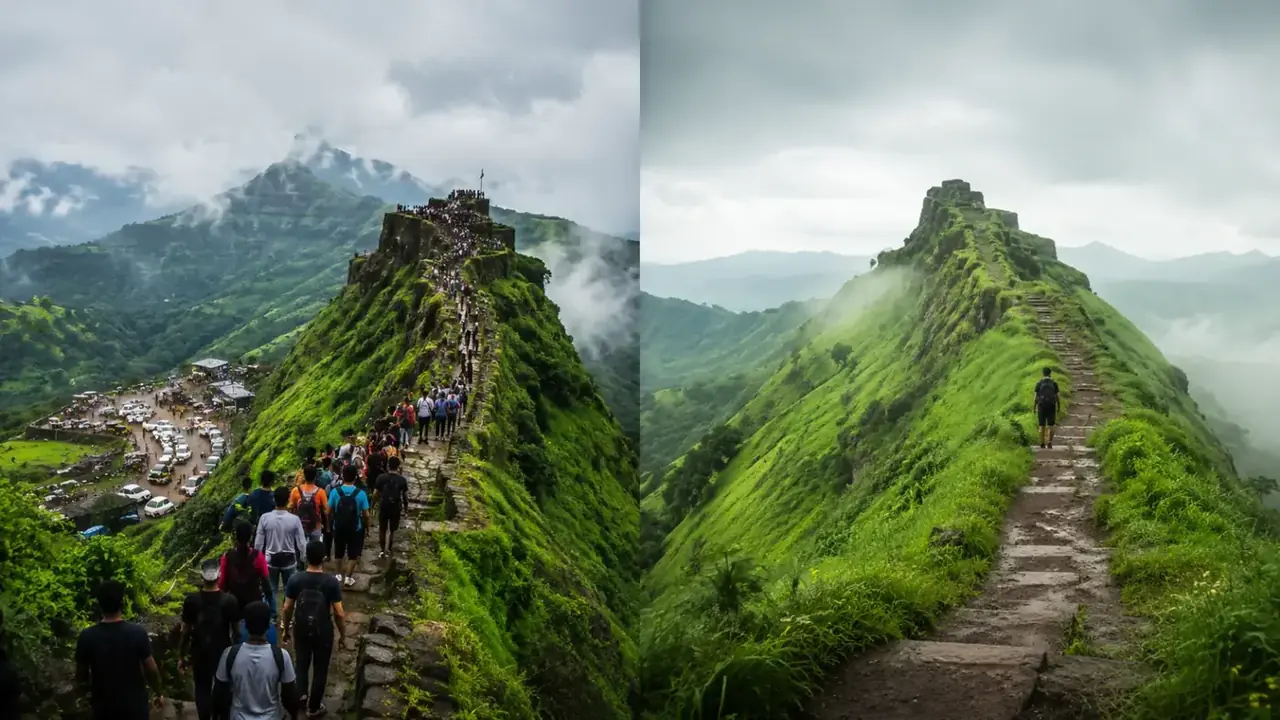
According to numbers published by an established Maharashtra trekking organizer, the first weekend of July alone saw roughly 3,000+ visitors at Devkund Waterfall, 2,000+ at Andharban, and around 2,000 each at Lohagad, Visapur, and Harihar Fort. These aren't small crowds spread across a wide area either, they're concentrated on narrow forest trails, single-file staircases, and small waterfall basins built for a fraction of that footfall.
Separately, data shared by a Himalayan trekking company (Bikat Adventures) analyzing their own booking patterns found that 74% of trekkers booked treks starting on a Saturday, another 12.8% on Sunday, and only a small minority chose weekday departures. While that specific data set is from Himalayan trekking, the same booking behavior shows up consistently across Sahyadri weekend trek operators, and it's exactly the pattern driving the crowd numbers above.
Solo Trekking Sahyadri: The Independent Trekking Shift Adding to the Problem
There's a second trend worth folding into this picture: more trekkers are choosing solo trekking in the Sahyadri region or heading out in small self-formed groups with friends, rather than booking through an organized trekking operator. This shift toward independent trekking in Maharashtra is becoming a real factor in why popular weekend trails feel busier than ever.
The cost gap is a real driver. According to a trekker's own published cost breakdown of the Sahyadri range, a typical trek through an organized trekking group runs roughly ₹1,000 to ₹1,500, while the same trek done independently, without a group, costs closer to ₹500 to ₹1,000. That's a meaningful part of the solo trek vs group trek cost difference in Maharashtra, and for weekend regulars doing multiple treks a month, it adds up fast.
A new kind of platform has emerged specifically because of this shift. Community-based trekking platforms have started positioning themselves around exactly this behavior, matching solo or small-group trekkers with other independent trekkers and verified community hosts, rather than booking a seat on a traditional paid batch. The existence of these platforms is itself evidence that a meaningful number of trekkers now want the flexibility of going independently while still finding some group structure for safety, a trend increasingly described as solo trekking Sahyadri or independent trekking Maharashtra in trekking community discussions.
Why this matters for weekend crowding specifically: organized trekking operators generally cap their batch sizes. Independent and solo trekkers face no such cap. On a popular monsoon weekend, a trailhead can see its "official" operator batch numbers look reasonable on paper while the actual footfall, once independent trekkers, local day-trippers, and multiple smaller unaffiliated groups are added in, is far higher. This is a meaningful part of why crowd figures at flagship spots have kept climbing even as individual operators talk about smaller, safer batch sizes.
The destinations most affected by this combined pressure (organized batches plus independent trekker footfall) currently include:
- Kalsubai Peak
- Harihar Fort
- Harishchandragad
- Devkund Waterfall
- Lohagad Fort
- Visapur Fort
- Aadrai Jungle Trek
- Kalu Waterfall
- Peb Fort (Vikatgad)
- Korigad Fort
- Ratangad Fort
- Rajgad Fort
- Irshalgad
- Tikona Fort
These are, almost without exception, the trails that combine three things: relatively easy access from Mumbai or Pune, a famous monsoon waterfall or an iconic photo spot (like Kalsubai's summit ladders or Harihar's staircase), and enough social media visibility that they've become default choices rather than one option among many. That combination is exactly what pulls both organized batches and independent trekkers to the same narrow trails on the same weekends. Our guide to one-day treks near Pune lists quieter alternatives worth trying instead.
Why Weekend Crowding Has Become a Safety Issue
Crowding on a wide, open trail is mostly just inconvenient. Crowding on a narrow, exposed one is genuinely dangerous, and the Sahyadris have several trails where that distinction matters a lot.
Harihar Fort is the clearest example. Its famous 117 rock-cut steps rise at a near-vertical 75-80 degree angle, one meter wide, with no side railing for much of the climb. According to current trek operator documentation, the fort is regularly banned on monsoon weekends specifically due to dangerous overcrowding, and while there's no official published fatality count, multiple accidents have been reported, primarily linked to bottlenecks where ascending and descending crowds collide on that narrow staircase. One operator's assessment is blunt about it: the fort itself is structurally safe, the danger is crowd-related, and trekking on a weekday reduces that risk by an estimated 95%.
Devkund Waterfall is the other well-documented case. Weekend crowding at Devkund has been directly linked to repeated bans following fatalities, to the point where local Forest Departments and village panchayats have had to step in and restrict access during peak monsoon weekends.
The underlying pattern is consistent: it's not that these trails are inherently more dangerous than others in the Sahyadris. It's that a manageable trail becomes hazardous once a few thousand people try to use it in the same 48-hour window.
What Changed in 2026: The Shift Toward Weekday Batches
This is a genuinely current development, not a longstanding trend. In June 2026, Pune-based trekking company TrekPanda launched dedicated weekday departures, running Tuesday, Wednesday, and Thursday batches across 18 Sahyadri treks for the monsoon season, at a slightly lower price than weekend batches, with the same trek leaders and group sizes.
According to the company, this decision came after three consecutive monsoon seasons of tracking the same problem: weekend batches for flagship trails were selling out within 24 to 48 hours of being announced, leaving large numbers of waitlisted trekkers, some of whom, by the company's own account, missed the entire monsoon window waiting for a weekend slot on trails like Andharban and Harihar Fort.
This matters beyond just one operator's business decision. It's a direct market response to the same overcrowding data covered above, and it signals that weekday trekking is becoming a genuine, actively promoted option rather than just something solo or flexible-schedule trekkers stumbled into on their own.
Weekend Trek: Pros and Cons
Pros: - The only realistic option for most working professionals and students - More batch options and departure dates to choose from, since this is when most operators run their main trips - Easier to convince friends or a larger group to join, since everyone's schedule aligns - Better availability of shared transport, since weekend batches typically fill faster and run more consistently
Cons: - Significantly higher crowd density on popular trails, sometimes into the thousands on a single trail in a single weekend - Increased risk of bottleneck accidents on narrow, exposed sections like Harihar Fort's staircase - Higher chance of last-minute booking closures, since flagship weekend batches often sell out within a day or two - More waiting time at narrow trail sections, water crossings, and popular photo spots - Higher likelihood of a trail being temporarily banned or restricted specifically because of weekend overcrowding
Weekday Trek: Pros and Cons
Pros: - Dramatically lower crowd density, with some operators estimating a 95% reduction in trail traffic - Safer experience on narrow or exposed sections, since there's no bottleneck pressure - A noticeably different, quieter experience of the forest itself, better wildlife and bird sightings, less noise, more of the natural monsoon soundscape - Often priced slightly lower than equivalent weekend batches - Easier last-minute booking, since weekday slots don't fill up nearly as fast
Cons: - Requires taking leave from work or college, which isn't realistic for everyone - Fewer batch date options for some operators, though this is actively improving as more companies add weekday departures - Smaller group sizes on some trails can mean less shared cost for private transport - Fewer people on the trail also means less immediate help nearby in case of an emergency, so solo or small-group weekday trekkers should be extra prepared
Side-by-Side Comparison
| Factor | Weekend Trek | Weekday Trek |
|---|---|---|
| Crowd density | Very high on popular trails (2,000-3,000+ on flagship routes) | Significantly lower, some estimates suggest up to 95% less |
| Safety on exposed trails | Higher accident risk from bottlenecks | Lower risk, more space to move carefully |
| Booking availability | Sells out fast, often within 24-48 hours | Generally easier to book, even last minute |
| Pricing | Standard or premium pricing | Often slightly discounted |
| Group size for logistics | Larger, easier to split transport costs | Smaller, may cost more per person for private transport |
| Trail and forest experience | Noisy, crowded, less wildlife visibility | Quieter, better for wildlife and photography |
| Suitability | Working professionals with fixed weekends | Flexible-schedule trekkers, remote workers, students on leave |
Which Option Should You Choose
- Choose a weekday trek if: you can take a day off, you're trekking a narrow or exposed trail like Harihar Fort, you want a genuinely quieter forest experience, or you're specifically trying to avoid the accident risk that comes with weekend bottlenecks
- Choose a weekend trek if: it's your only realistic option given work or college, you're trekking a wider, less bottleneck-prone trail, or you're organizing a larger group where weekend availability matters more than crowd size
- If you must trek on a weekend: pick trails that aren't on the "most crowded" list, start earlier than the main crowd, and specifically avoid narrow staircase-style routes like Harihar Fort during peak monsoon weekends if you can help it
Practical Tips for Both Options
- Check current crowd advisories or recent trip reports for your specific trail before booking, crowding patterns shift trek to trek and season to season
- If trekking on a weekend, start your climb as early as possible to stay ahead of the main crowd surge
- If trekking on a weekday with a smaller group, make sure someone outside the group knows your route and expected return time, since there's less immediate help around if something goes wrong
- Watch for temporary bans or entry restrictions, especially on trails with a history of weekend overcrowding incidents like Devkund and Harihar Fort
- If booking through an operator, specifically ask whether they run weekday batches; more companies are adding them, but not all advertise it clearly
Frequently Asked Questions
1. Is weekday trekking actually safer than weekend trekking in the Sahyadris? On trails with narrow, exposed sections like Harihar Fort's rock-cut staircase, yes. Operators report an estimated 95% drop in crowd-related risk on weekdays, since most documented accidents on such trails are linked to bottlenecks caused by overcrowding, not the terrain itself.
2. How crowded do Sahyadri treks actually get on weekends? Documented numbers from the first weekend of July in a recent monsoon season showed over 3,000 visitors at Devkund Waterfall and around 2,000 each at Andharban, Lohagad, Visapur, and Harihar Fort.
3. Are weekday trek batches available in 2026? Yes, and increasingly so. TrekPanda launched dedicated weekday departures across 18 Sahyadri treks in June 2026, following three consecutive seasons of weekend batches selling out within 24-48 hours.
4. Is weekday trekking cheaper than weekend trekking? In at least one documented case, yes, slightly. Some operators price weekday batches a bit lower than weekend ones to encourage bookings on less popular days.
5. Why do some Sahyadri treks get banned on weekends specifically? Trails like Harihar Fort and Devkund Waterfall have documented histories of weekend-specific bans following overcrowding-related accidents, since a manageable trail becomes genuinely hazardous once too many people are funneled through a narrow section at once.
6. What percentage of trekkers actually book weekend batches over weekday ones? Booking data shared by one Himalayan trekking operator found 74% of trekkers chose Saturday departures and 12.8% chose Sunday, leaving only a small minority on weekday batches. Sahyadri weekend crowd numbers suggest a similar pattern.
7. Should beginners choose a weekend or weekday trek? Either can work, but if a beginner is attempting a narrow or exposed trail specifically, a weekday trek is the safer starting choice, since there's more room to move at your own pace without crowd pressure.
8. Is the shift toward solo and independent trekking making weekend crowding worse? It's a contributing factor. Independent trekkers and small unaffiliated groups aren't limited by the batch-size caps that organized operators use, so trailhead footfall on a busy weekend can be significantly higher than what official operator numbers alone suggest, especially at destinations like Kalsubai, Harihar Fort, and Devkund.
The choice between a weekend and weekday trek in the Sahyadris used to just be about your work schedule. It's increasingly become a genuine safety consideration too, especially on trails like Harihar Fort, where the documented risk isn't the terrain, it's the crowd. The 2026 shift toward dedicated weekday batches from operators like TrekPanda is a direct response to years of the same weekend overcrowding pattern, and it's worth taking seriously if your schedule allows it.
If you can trade a Saturday for a Tuesday, especially on a narrow or exposed trail, the trade genuinely pays off: fewer people, better wildlife sightings, easier booking, and a meaningfully lower accident risk.
Ready for Your Next Adventure?
Don't just read about it — come experience it. Book your spot on Sahyadri Treks with certified trek leaders, small groups, and everything organised for you.
🏷 weekend trek vs weekday trek, Sahyadri trek crowding, weekday trekking Maharashtra, Harihar Fort overcrowding
Be the first to comment on this post.