Introduction
Most treks go beautifully from start to finish. That's the truth, and it's exactly why smart emergency planning for remote Sahyadri treks matters: not because trouble is likely, but because a little preparation lets you head into wild, far-flung trails with total confidence.
Remote Sahyadri treks like Vasota, Sandhan Valley, or the deeper reaches of the ranges are stunning precisely because they're away from it all. That same remoteness means help is farther away, so the answer is simple. You bring the plan with you.
This guide shows how to build an emergency plan that fits in your head and your backpack: knowing your escape routes, the nearest medical help, who to call, and how to communicate when there's no signal. Do this once and every remote trek becomes calmer and more enjoyable.
Table of Contents
- Why Remote Treks Need a Plan
- Research Before You Go
- Evacuation Routes and Escape Points
- Nearest Hospitals and Medical Help
- Emergency Contacts to Carry
- Communication When There's No Signal
- Building Your Emergency Kit
- How to Respond When Something Goes Wrong
- Practical Tips
- Common Mistakes
- Expert Insights
- Frequently Asked Questions
- Ready for Your Next Adventure?
Why Remote Treks Need a Plan
On a popular trail near a town, help is close and other trekkers are around. On a remote route, both of those disappear. You might be hours from a road, out of mobile coverage, and far from the nearest clinic.
That's not a reason to skip these gorgeous treks. It's a reason to prepare differently. An emergency plan turns "what if" into "here's what we'd do," which is the whole point.
A good plan answers four questions before you ever set foot on the trail:
- How would we get an injured person out? (evacuation routes)
- Where's the nearest real medical help? (hospitals and clinics)
- Who do we call, and how? (contacts and communication)
- What do we carry to handle problems ourselves? (kit and skills)
Answer those and you've done 90% of the work. The rest is staying calm, which comes naturally when you already know the answers. Remote giants like the Salher Fort trek are exactly where this planning matters most.
Research Before You Go
Emergency planning starts at home, not at the trailhead. A short research session the week before pays off enormously.
Before a remote trek, find out:
- The full route, including where it's exposed, where it's tricky, and where you could exit early.
- Mobile coverage along the route (which networks work, and where the dead zones are).
- The nearest base village and its key contacts (a homestay, a local guide, a shop owner).
- The nearest medical facilities and roughly how long they'd take to reach.
- Recent trail conditions, especially in monsoon, from recent trekkers or local groups.
- The weather and any alerts for your dates.
Write the essentials down somewhere that doesn't need battery or signal: a small note in your pack, plus screenshots saved on your phone. This is one area where joining an experienced organizer is a huge shortcut, since a good team already knows the exit points, local contacts, and hospital options for the routes they run.
Evacuation Routes and Escape Points
An escape route (also called a bail-out point) is a shorter or easier way off the trail if someone gets hurt, the weather turns, or the group runs out of time. Knowing these in advance is one of the most valuable pieces of planning.
How to think about escape routes:
- Identify the quickest way down to a road or village from different points along the trail, not just the way you came.
- Note where the trail passes closest to a motorable road, since that's where a vehicle could meet you.
- Mark any midway points where you could shorten the trek if needed.
- Consider how you'd move an injured person on each option. A gentle, short descent beats a shorter but cliff-heavy one.
On the trail, keep a rough sense of "if something happened right now, which way would we head?" That running awareness costs nothing and makes a real difference. Trek leaders do this instinctively, constantly updating the group's best exit as the day unfolds.
Nearest Hospitals and Medical Help
For any remote trek, know where you'd go for medical help before you need it.
What to note down:
- The nearest primary health center or clinic to the base village (for minor issues).
- The nearest well-equipped hospital in a larger town (for anything serious).
- Rough travel time from the trailhead to each.
- Whether an ambulance can reach the base village, or whether you'd need private transport.
Keep this info in your written note and as a screenshot. When someone's hurt and adrenaline is high, having the hospital name, direction, and a rough travel time already written down keeps decisions fast and clear.
A general note on medical situations: when an injury or illness looks serious, prioritize getting the person to professional medical help, and don't rely on trailside guesses. Conditions and the right response vary from person to person, so professional care is always the goal.
Emergency Contacts to Carry
Your phone's contact list is useless if the phone is dead or lost. Carry emergency contacts in more than one form.
Contacts to have ready:
- A trusted person at home who knows your plan and expected return time.
- The base village contact (homestay, guide, or local you arranged with).
- Your trek organizer's number, if you're with one.
- Local emergency numbers: in India, 112 is the national emergency number, and 108 is widely used for ambulance services (verify the current local numbers for your area, as services vary by region).
- Nearest police station or forest department office for treks in protected areas.
How to carry them:
- Written on paper in your pack, waterproofed.
- Saved as screenshots on your phone.
- Shared with a home contact before you leave, along with your route and timing.
That home contact is your safety net. Tell them your plan and when you'll check in, and agree what they should do if you don't. It's the simplest, most powerful piece of the whole system.
Communication When There's No Signal
Remote Sahyadri treks often have long stretches with no mobile coverage. Plan around that instead of hoping for bars.
Communication strategies:
- Send an "I'm starting now" and "I'm safely down" message to your home contact whenever you do have signal.
- Learn where signal exists on your route (often on ridges and summits, rarely in valleys) so you know where you could get a message out in an emergency.
- Conserve phone battery by using airplane mode in dead zones and carrying a power bank. A charged phone is worthless if the battery died hours ago.
- Agree on a check-in schedule with your home contact, and a plan for what they do if you miss it.
- For serious remote expeditions, some groups carry satellite communicators or GPS messengers that work without mobile networks. For most Sahyadri day treks this is overkill, but it's worth knowing the option exists.
The core principle: someone who isn't on the trek should always know where you are and when to worry. That external awareness is what turns a missed return into a timely response. If your plan involves darkness, combine this with our night trek safety guide.
Building Your Emergency Kit
Your kit lets you handle small problems on the spot and stabilize bigger ones until help arrives.
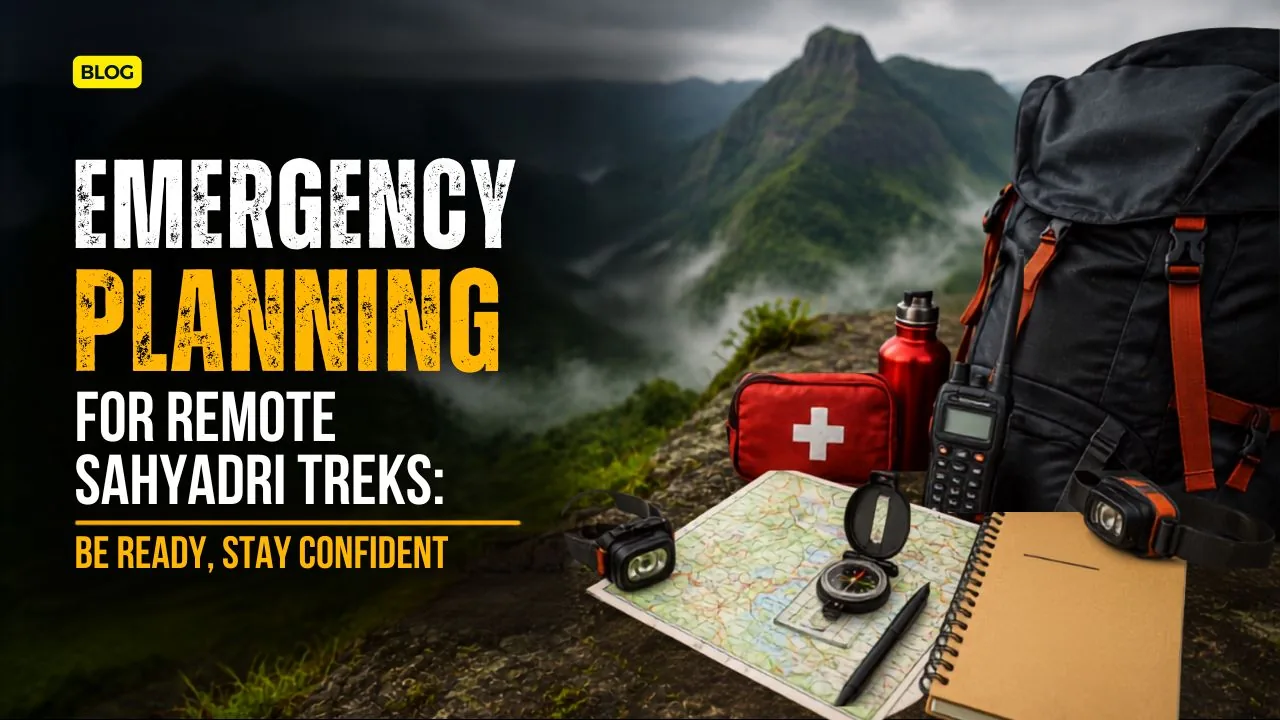
A remote-trek emergency kit includes:
- A well-stocked first aid kit (bandages, antiseptic, painkillers, blister care, any personal medication, ORS).
- A power bank and charging cable to keep your phone alive.
- A headlamp with spare batteries, in case an emergency delays you into darkness.
- A whistle to signal for help (three blasts is a recognized distress signal).
- An emergency shelter or space blanket for warmth if you're stuck.
- Extra food and water beyond your day's needs.
- A basic repair kit (tape, cord) for gear failures.
- Your written contacts and route notes, waterproofed.
Keep this kit consistent across treks so you never have to rebuild it. Every item is small and light, and together they cover the vast majority of remote-trail situations.
How to Respond When Something Goes Wrong
If a problem does arise, a calm, ordered response makes everything better. Keep this simple sequence in mind.
- Stop and stay calm. Panic causes bad decisions. Take a breath and assess.
- Make the scene safe. Move away from immediate hazards (cliff edge, rising water, exposed ridge) before anything else.
- Assess the person or problem. How serious is it? Can they walk? Is it getting worse?
- Give first aid within your ability, and keep the person warm and reassured.
- Decide: self-evacuate or call for help. Minor issues, walk out via your escape route. Serious ones, send for help while stabilizing the person.
- Communicate. Get a message to your home contact, organizer, or emergency services as soon as you can reach signal.
- Keep the group together and informed. Assign roles: someone leads, someone tends the injured, someone goes for signal if needed.
This is where trekking with an experienced, trained group truly shows its worth. A leader who's rehearsed these steps keeps everyone calm and coordinated, which is far harder to manage alone on a remote trail.
Practical Tips
- Tell a home contact your route and return time before every remote trek.
- Screenshot maps, contacts, and hospital info so they work offline.
- Carry a power bank and use airplane mode in dead zones.
- Note escape points as you walk, not just before you start.
- Pack a whistle, headlamp, and space blanket even on day treks.
- Keep contacts on waterproof paper, not just in your phone.
- Agree a "missed check-in" plan with someone at home.
- On remote or first-time routes, go with an organizer who already knows the exits, contacts, and conditions.
Common Mistakes
- Telling no one your plan, so nobody knows to raise the alarm if you're overdue.
- Relying entirely on the phone for maps, contacts, and communication, then having it die.
- Assuming there'll be signal when remote valleys often have none.
- Not knowing any escape route except the full way back.
- Skipping the first aid kit "because it's just a day trek."
- Ignoring return timing, then getting caught out far from help after dark.
- Heading into a remote route solo and unprepared, the situation behind most avoidable trouble.
- Not researching the nearest hospital until an emergency forces it.
Expert Insights
Experienced organizers treat emergency planning as invisible groundwork done long before a trek starts. For every remote route they run, they already know the escape points, the local contacts, the coverage gaps, and the nearest medical options. That preparation is why guided remote treks feel relaxed rather than risky; the safety net is already in place.
They also build communication discipline into every trip: a known start message, a known finish message, and someone off the mountain who's tracking the group. This simple external awareness is the single biggest factor in how quickly help arrives when it's genuinely needed.
Finally, they rehearse calm. Leaders train to slow down, make the scene safe, and work the problem step by step rather than reacting in panic. That composure spreads to the whole group, and it's one of the strongest arguments for tackling remote and unfamiliar Sahyadri routes with a seasoned team rather than improvising alone.
Frequently Asked Questions
1. How do I plan for emergencies on a remote trek? Research your route, note escape points and the nearest hospital, carry emergency contacts on paper and phone, tell a home contact your plan and return time, and pack a first aid and emergency kit. Preparation is most of the work.
2. What emergency numbers should I carry for a Sahyadri trek? Carry 112 (India's national emergency number) and 108 (widely used for ambulances), plus your base village contact, organizer, and nearest police or forest office. Verify current local numbers, since services vary by region.
3. How do I get help on a trek with no mobile signal? Know where signal exists on your route (often ridges and summits), conserve battery with airplane mode and a power bank, and always tell a home contact your plan so they can raise the alarm if you miss a check-in.
4. What is an escape route on a trek? An escape route, or bail-out point, is a shorter or easier way off the trail to a road or village if someone is hurt, the weather turns, or you run low on time. Identify these before and during the trek.
5. What should be in a trekking emergency kit? A first aid kit, power bank, headlamp with spare batteries, whistle, emergency shelter or space blanket, extra food and water, a small repair kit, and waterproofed route notes and contacts.
6. What's the first thing to do in a trekking emergency? Stop and stay calm, then make the scene safe before anything else. Assess the situation, give first aid within your ability, decide whether to walk out or call for help, and communicate as soon as you have signal.
7. Are remote Sahyadri treks safe? Yes, with proper planning. Knowing your escape routes, medical options, and communication plan, plus trekking with an experienced team on unfamiliar routes, makes remote treks both safe and deeply rewarding.
Emergency planning for remote Sahyadri treks isn't about expecting the worst. It's about earning the freedom to explore the wildest, most beautiful corners of the range with a clear head. Know your escape routes, your nearest medical help, your contacts, and your communication plan, and carry a simple emergency kit.
Do that quiet preparation once and it becomes second nature. Then the remoteness that makes these treks so special becomes pure adventure, backed by a plan you'll almost certainly never need to use.
Ready for Your Next Adventure?
Don't just read about it — come experience it. Book your spot on Sahyadri Treks with certified trek leaders, small groups, and everything organised for you.
🏷 trek emergency plan, evacuation route planning trekking, rescue communication on treks, what to do in a trekking emergency, remote trek safety preparation, how to plan for emergencies on a remote trek
Be the first to comment on this post.